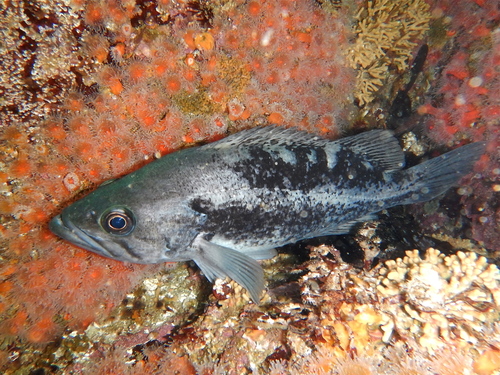
Black Rockfish
Sebastes melanops
The iconic 'black bass' of the Pacific, these schooling rockfish are the lively heart of the West Coast's kelp forests and rocky reefs.
Quick Identification
Size
Typically 12-20 inches (30-51 cm) long; weight usually between 2-6 lbs (0.9-2.7 kg), though they can reach 24 inches and 10 lbs.
Colors
Mottled charcoal grey to jet black on the back, fading to a lighter grey or white belly. Distinctive black spots on the dorsal fin.
Key Features
- Dark charcoal to black mottled coloration
- Large mouth with the lower jaw slightly protruding
- Dorsal fin has 13 spines with black spotting on the membrane
- Broad, rounded tail fin
- Lacks the prominent head spines found in other rockfish species
When You’ll See Them
Geographic range
Where Does the Black Rockfish Live?
Native to the coastal waters of the North Pacific Ocean, the Black Rockfish thrives along the rugged western coastline of North America. Their range begins in the frigid waters surrounding the Aleutian Islands in Alaska and stretches southward through British Columbia and the Pacific Northwest, reaching as far as Santa Monica Bay in Southern California. They are most abundant in the nutrient-rich upwelling zones off the coasts of Oregon and Washington, where they dominate the nearshore rocky habitats.
Basemap © OpenStreetMap contributors
Behavior
Black Rockfish are one of the most social and active members of the rockfish family. Unlike many of their cousins who prefer to hide in deep rocky crevices, these fish are frequently found in the mid-water column or hovering just above the canopy of giant kelp forests. They are known for forming massive schools that can include hundreds or even thousands of individuals, often mixing with other species like Blue or Yellowtail Rockfish.
These fish exhibit a high degree of site fidelity, often returning to the same rocky reef or kelp bed year after year. They are opportunistic hunters that become particularly active during tidal changes when currents bring in fresh supplies of baitfish and plankton. While they are generally wary of large predators, they are curious enough to approach stationary underwater objects, making them excellent subjects for patient observers and automated camera systems.
EverydayEarth exclusive
Camera Tips
Capturing Black Rockfish requires an underwater setup, ideally positioned near structural edges such as the transition point where a rocky reef meets a sandy bottom. If you have a dock or a backyard shoreline, mount your camera housing 10 to 15 feet deep, facing a vertical rock face or a kelp stand. These fish are highly attracted to structure, so the more 'nooks' in your frame, the more likely they are to cruise through. Use a wide-angle lens to capture the full scale of their schooling behavior.
Lighting is the biggest challenge when filming these dark-colored fish. If using an AI-powered camera, position it so the sun is behind the lens or slightly to the side; this prevents the fish from appearing as a simple black silhouette. To trigger more frequent visits, you can use a 'chum' bag filled with oily fish scraps or salmon roe secured near the lens. The scent will draw them in, and their natural curiosity will keep them in front of the sensor as they investigate the source.
Pay close attention to tidal cycles for the best results. Black Rockfish are most likely to hold stationary positions in front of your camera during 'slack water'—the period between high and low tide when the current stops. During heavy currents, they may move to deeper water or hide behind rocks to save energy. In the spring and summer, look for 'recruitment' events where clouds of juvenile rockfish appear; these tiny versions of the species are excellent for testing the sensitivity of your AI detection models.
Similar Species
Species that look similar or are commonly confused with Black Rockfish.
Frequently Asked Questions
Record Black Rockfish at your habitat
Connect a camera to start building your own species record — AI identifies every visitor automatically.