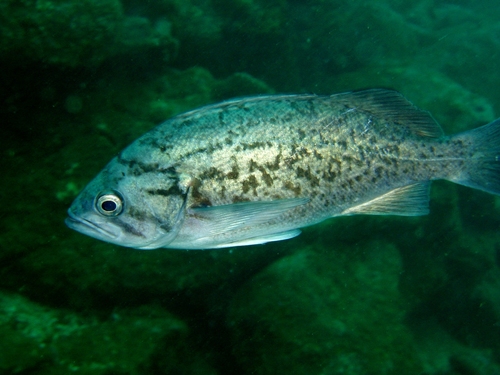
Blue Rockfish
Sebastes mystinus
The Blue Rockfish is a vibrant, schooling sentinel of the Pacific kelp forests, known for its striking coloration and social mid-water lifestyle.
Quick Identification
Size
Typically 25-40 cm (10-16 inches) long, reaching a maximum of 53 cm (21 inches) and weighing up to 3.8 kg (8.3 lbs).
Colors
Uniform bluish-gray to charcoal back with lighter gray sides and a silver-white belly; often features subtle, darker blotches on the upper body.
Key Features
- Oval, compressed body shape
- Small mouth with a lower jaw that does not project significantly
- Two dark diagonal bands extending back from the eyes
- Thirteen venomous spines on the dorsal fin
When You’ll See Them
Geographic range
Where Does the Blue Rockfish Live?
The Blue Rockfish is a hallmark species of the North American Pacific coast. It is natively found in the cold, nutrient-rich waters stretching from central Oregon down to northern Baja California, Mexico. While they are most abundant in the central California region, they are a vital component of the nearshore reef ecosystems throughout the California Current system.
Basemap © OpenStreetMap contributors
Behavior
Blue Rockfish are highly social and are one of the few rockfish species that spend significant time in the middle of the water column rather than resting on the bottom. They form massive, swirling schools that can contain thousands of individuals, often congregating around the protective stalks of giant kelp forests. This schooling behavior provides safety from predators like seals, sea lions, and larger fish.
Unlike their more territorial cousins, Blue Rockfish are active foragers that move with the currents. They are known for their inquisitive nature and will often approach divers or underwater cameras to investigate. During the day, they are most active as they hunt for drifting prey, while at night they tend to settle into rock crevices or kelp thickets to rest and avoid nocturnal predators.
EverydayEarth exclusive
Camera Tips
To capture Blue Rockfish on camera, you will need a waterproof action camera or a dedicated underwater housing. Because these fish are pelagic (mid-water) schoolers, avoid placing your camera directly on the sandy bottom where it might be obscured. Instead, mount your camera to a weighted tripod on a rocky ledge or use a tethered buoy system to suspend the lens about 2-3 meters above the reef. Positioning the camera near a kelp 'forest' edge is ideal, as the fish use these areas as transit corridors.
Lighting is the biggest challenge underwater. Aim to record during the middle of the day when the sun is at its zenith to ensure maximum light penetration through the water column. If you are filming in deeper water or on overcast days, a wide-beam underwater video light can help bring out the subtle blue and purple hues of the fish’s scales, which often appear muddy or gray in low-light conditions.
Blue Rockfish are naturally curious, so you often don't need bait to attract them. However, if you want to ensure a close-up, a 'chum pod'—a small mesh bag filled with chopped squid or shrimp—placed just out of the frame can create a feeding frenzy that looks spectacular on video. Set your camera to a high frame rate (60fps or higher) to capture the fluid, synchronized movement of the school without motion blur.
Similar Species
Species that look similar or are commonly confused with Blue Rockfish.
Black Rockfish
Larger mouth extending past the eye and dark spots on the dorsal fin.
Deacon Rockfish
Nearly identical but possesses a more solid dark coloration and subtle genetic differences; often found in deeper water.
Olive Rockfish
Greenish-brown tint rather than blue, with light blotches along the back.
Frequently Asked Questions
Record Blue Rockfish at your habitat
Connect a camera to start building your own species record — AI identifies every visitor automatically.