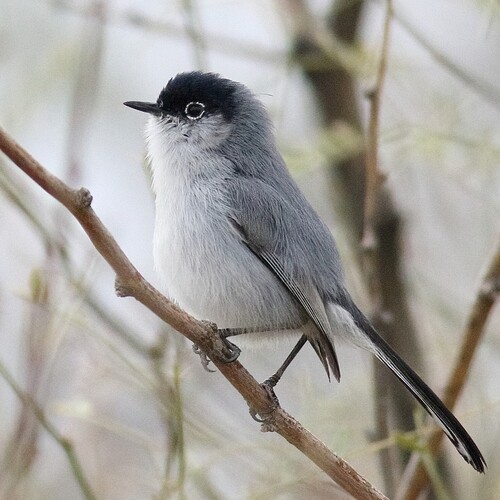
Black-tailed Gnatcatcher
Polioptila melanura
The Black-tailed Gnatcatcher is a pint-sized powerhouse of the American Southwest. A year-round desert dweller, this restless songbird is famous for its cocked tail and its ability to thrive in the intense heat of the Sonoran sun.
Quick Identification
Size
Length: 11-13 cm (4.3-5.1 in); Wingspan: 14-15 cm (5.5-5.9 in); Weight: 5-7 g (0.18-0.25 oz)
Colors
Blue-gray upperparts and whitish underparts; males have a prominent black cap during breeding season; tails are primarily black with narrow white outer edges.
Key Features
- Jet-black cap on males during summer
- Long, thin black tail with minimal white on the underside
- Small, needle-like bill for insect gleaning
- Constant tail-flicking and restless movement
When You’ll See Them
Geographic range
Where Does the Black-tailed Gnatcatcher Live?
Native to the North American Southwest, the Black-tailed Gnatcatcher is a permanent resident of the Sonoran and Chihuahuan Deserts. Its range extends from southeastern California and southern Nevada through Arizona, New Mexico, and into West Texas. South of the border, it is widely distributed across the northern half of Mexico, reaching as far south as San Luis Potosí. This bird is a true desert specialist, rarely found outside of these arid landscapes.
Basemap © OpenStreetMap contributors
Behavior
The Black-tailed Gnatcatcher is a tiny, hyperactive bundle of energy. It is rarely seen sitting still, instead hopping rapidly through desert scrub and low trees in search of food. These birds are known for their 'tail-cocking' behavior, where they hold their long tails at an upright angle and flick them side-to-side, a movement thought to flush out hidden insects from the foliage.
Socially, they are usually found in pairs or small family groups. They are highly territorial during the breeding season and will boldly scold intruders with a variety of raspy, wheezy calls. Despite their small size, they are remarkably hardy, remaining in the scorching heat of the Sonoran and Chihuahuan deserts year-round rather than migrating to more temperate climates.
EverydayEarth exclusive
Camera Tips
To capture the Black-tailed Gnatcatcher on a backyard camera, your best bet is a water feature. In the parched desert environment, a shallow birdbath or a misting system is an irresistible draw. Place your camera roughly 3 to 5 feet from the water source, ideally at a low angle (about 2 feet off the ground) to match the bird's natural foraging height in low scrub.
Because these birds are incredibly small and move with lightning speed, your camera settings are critical. Use a high-speed trigger mode if available. If your AI camera supports video, set it to 10-15 second clips; these birds often perform a 'dance' at the water's edge, dipping and flicking their tails, which makes for far more engaging footage than a single, often blurry, still photo.
For the best lighting, position your camera facing north or south to avoid the harsh glare of the desert sun. Gnatcatchers are early risers, so ensure your camera is active by dawn. They are particularly attracted to native desert plants like Desert Lavender or Creosote, so if you have these in your yard, mount your camera nearby to catch them gleaning for insects during the peak morning hours.
Lastly, consider the 'Small Animal' sensitivity setting on your PIR sensor. Because they weigh about the same as a nickel, a standard trigger might not always detect their presence. Narrowing the field of view and focusing on a specific 'landing branch' near your water source will significantly increase your success rate.
Similar Species
Species that look similar or are commonly confused with Black-tailed Gnatcatcher.
Blue-gray Gnatcatcher
Larger white edges on the underside of the tail and lacks the full black cap in males; prefers more wooded or riparian habitats.
California Gnatcatcher
Found specifically in coastal sage scrub of California; has a darker gray belly and a slightly different, kitten-like call.
Verdin
Similar size and habitat, but has a yellow head and a chestnut shoulder patch rather than a black cap and long tail.
Frequently Asked Questions
Record Black-tailed Gnatcatcher at your habitat
Connect a camera to start building your own species record — AI identifies every visitor automatically.