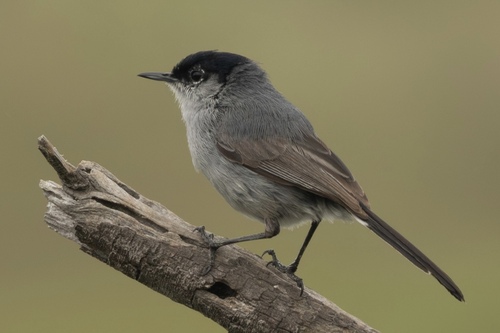
California Gnatcatcher
Polioptila californica
Meet the 'kitten of the scrub,' a tiny gray acrobat that calls the rare coastal sage of California home. With its cocked tail and spirited personality, this elusive songbird is a treasure for any backyard observer.
Quick Identification
Size
Length: 11 cm (4.3 in); Wingspan: 14 cm (5.5 in); Weight: 5-7 g (0.18-0.25 oz)
Colors
Primarily lead-gray plumage with lighter gray-white underparts. Breeding males have a distinct black cap; females and non-breeding males have a gray cap and a thin white eye-ring.
Key Features
- Slender body with a long, thin black tail often held cocked upward
- Breeding males feature a solid black cap from bill to nape
- Distinctive kitten-like 'mew' call
- Very little white on the underside of the tail compared to other gnatcatchers
When You’ll See Them
Geographic range
Where Does the California Gnatcatcher Live?
Native to the coastal regions of the southwestern United States and the Baja California peninsula, the California Gnatcatcher is a true specialist of the Pacific coast. Its core range is remarkably narrow, stretching from Ventura County southward through San Diego and extending deep into Mexico along the arid slopes of Baja California. Because it relies entirely on coastal sage scrub, its distribution is fragmented into small pockets where this specific habitat remains protected from urban development.
Basemap © OpenStreetMap contributors
Behavior
Unlike many other songbirds, they rarely fly across large open spaces, preferring to stay within the protective cover of low-growing vegetation. While they are usually solitary or found in pairs, they may occasionally join loose 'foraging guilds' with other small birds like bushtits during the winter months. Their interactions with humans are minimal, as they are habitat specialists that strictly avoid urban environments unless those areas directly border native scrubland.
EverydayEarth exclusive
Camera Tips
Water is the best lure for this species. In the arid climate of Southern California, a shallow birdbath with a solar-powered dripper or a small recirculating fountain acts like a magnet. Position your AI camera roughly 3 feet away from the water source at a height of 2 to 4 feet. Gnatcatchers are low-profile birds that rarely feed or bathe high in the trees, so keeping the camera low to the ground will provide the most intimate, eye-level perspective.
Since these birds are most active in the early morning, ensure your camera's lens is shielded from direct sunrise flare. Early morning light also highlights the subtle blue-gray tones of their feathers and the male's black cap. If you use a camera with AI detection, set the sensitivity to 'High' to account for their tiny size and quick, flitting movements. Avoid using loud alerts or bright white-light flashes, as these birds are naturally shy and easily startled by sudden changes in their environment.
Similar Species
Species that look similar or are commonly confused with California Gnatcatcher.
Frequently Asked Questions
Record California Gnatcatcher at your habitat
Connect a camera to start building your own species record — AI identifies every visitor automatically.