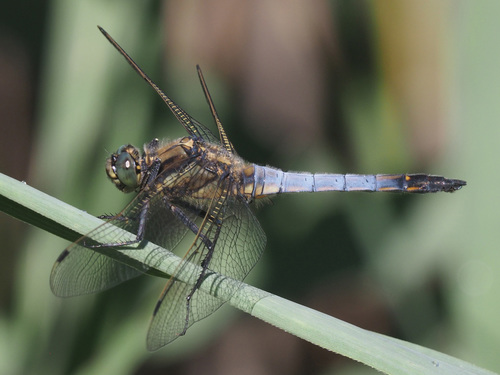
Black-tailed Skimmer
Orthetrum cancellatum
A master of the sunny shoreline, the Black-tailed Skimmer is famous for its powder-blue color and its unique habit of sunbathing on warm rocks and garden paths.
Quick Identification
Size
Body length: 45–55 mm (1.8–2.2 in); Wingspan: 70–85 mm (2.7–3.3 in)
Colors
Males have a powder-blue abdomen with a distinct black tip; females are golden-yellow or brown with two black 'ladder' stripes.
Key Features
- Sky-blue abdomen with black segments at the very tip (males)
- Two black longitudinal stripes on a yellow abdomen (females)
- Clear wings with small, dark wing spots (pterostigmata)
- Habit of resting on bare ground or stones rather than vegetation
When You’ll See Them
Geographic range
Where Does the Black-tailed Skimmer Live?
The Black-tailed Skimmer is a widespread species native to the Palearctic region, ranging across almost all of Europe and eastward through Central Asia to China. It is also found along the Mediterranean coast of North Africa. While it thrives in the warm southern regions of its range, it has steadily expanded its presence northward into Scandinavia and the British Isles over recent decades, becoming a common sight in lowland wetlands.
Basemap © OpenStreetMap contributors
Behavior
Males are fiercely defensive of their shoreline territories, frequently engaging in high-speed aerial chases to drive off rivals. They are ambush predators, often returning to the exact same sun-baked perch after a successful hunting sortie. While they are wary and quick to fly when approached, they can be remarkably consistent in their choice of basking spots, making them a rewarding subject for patient observers.
EverydayEarth exclusive
Camera Tips
Dragonflies are visual hunters and aren't attracted to traditional food baits. However, you can 'set the stage' by placing a piece of dark slate or a weathered wooden plank in a sunny, wind-sheltered spot near your pond. This creates a high-contrast backdrop that makes the male's blue abdomen or the female's yellow markings pop in photos. Ensure the camera is positioned so the sun is behind you to avoid lens flare and to fully illuminate the iridescent wings.
Since dragonflies move with incredible speed, use the highest shutter speed or 'burst' mode available on your device. If your AI camera has a 'Small Animal' or 'Insect' detection mode, ensure it is enabled. The best time for filming is mid-day when the sun is highest; this is when their metabolism is most active and their colors appear most vibrant. Be mindful of moving grass in the background, as the high sensitivity required to trigger on a dragonfly may result in many false-positive videos if the wind picks up.
Similar Species
Species that look similar or are commonly confused with Black-tailed Skimmer.
Broad-bodied Chaser
Much broader, flatter abdomen and dark brown triangular patches at the base of the wings.
Keeled Skimmer
Smaller and lacks the distinct black tip on the abdomen; usually found near bogs or acidic water.
Southern Skimmer
The male's blue coloration extends further toward the head, and it lacks the heavy black 'ladder' markings seen on female Black-tailed Skimmers.
Frequently Asked Questions
Record Black-tailed Skimmer at your habitat
Connect a camera to start building your own species record — AI identifies every visitor automatically.