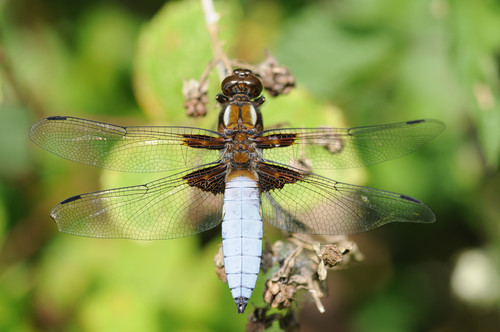
Broad-bodied Chaser
Libellula depressa
The Broad-bodied Chaser is an unmistakable garden favorite, boasting a uniquely wide, flattened abdomen and a bold personality. Whether it's the sky-blue male or the golden female, these 'pioneer' dragonflies are a sign of a healthy, thriving backyard pond.
Quick Identification
Size
Length 39-48 mm (1.5-1.9 in); Wingspan 70-80 mm (2.8-3.1 in)
Colors
Males feature a distinctive powder-blue (pruinose) abdomen with yellow spots on the sides. Females and immature males are golden-brown with similar yellow side markings. Both sexes have dark brown triangular patches at the base of all four wings.
Key Features
- Broad, flattened abdomen significantly wider than most dragonflies
- Dark brown triangular patches at the base of the wings
- Male has a pale blue abdomen, female is golden-brown
- Yellow spots visible along the edges of the abdomen
When You’ll See Them
Geographic range
Where Does the Broad-bodied Chaser Live?
The Broad-bodied Chaser is a widespread and common sight across the Palearctic, covering nearly all of Europe except for the furthest northern reaches of Scandinavia. Its native territory extends from the British Isles across the continent to the Middle East and Central Asia. It thrives in lowland regions and is particularly well-established in the temperate landscapes of Western and Central Europe, where it is a frequent visitor to suburban gardens and urban parks.
Basemap © OpenStreetMap contributors
Behavior
The Broad-bodied Chaser is a bold, territorial dragonfly known for its 'perch and wait' hunting strategy. It spends much of its day sitting on a prominent twig or reed near the water's edge, launching rapid, darting sorties to snatch flying insects from the air or to chase away rival males. They are powerful flyers, capable of sudden bursts of speed and intricate aerial maneuvers.
This species is famously a pioneer. It is often the very first dragonfly to colonize a newly created garden pond, sometimes appearing within days of the pond being filled. They are highly active in bright sunshine, frequently returning to the same favorite perch after an inspection flight, which makes them an excellent subject for observation and photography.
EverydayEarth exclusive
Camera Tips
To successfully capture the Broad-bodied Chaser on a backyard camera, focus on their territorial habits. These dragonflies almost always use a specific 'launchpad'—a vertical stick, reed, or bamboo cane that stands out from the rest of the pond vegetation. Identify this favorite perch and position your camera roughly 0.5 to 1 meter away. A side-on or slightly low-angle shot will best showcase the unique 'broad' profile of their abdomen and the dark wing patches.
Timing and light are everything for this species. They are most active during the hottest, sunniest part of the day. Ensure your camera is positioned so the sun is behind it or to the side, as direct sunlight is required to make the male's powder-blue abdomen 'pop' against the background. If your camera has a high-speed trigger or 'burst' mode, use it; their take-off and landing happen in the blink of an eye.
If you don't have a natural perch, you can easily create one. Push a sturdy, weathered stick into the pond margin at a 45-degree angle, making sure it is the tallest point in that immediate area. Broad-bodied Chasers are highly attracted to these prominent vantage points. Avoid placing the camera where tall grass might blow in front of the sensor, as the movement will trigger the camera and drain the battery during the breezy summer days when these insects are active.
Similar Species
Species that look similar or are commonly confused with Broad-bodied Chaser.
Scarce Chaser
The male is blue but has a black tip to its abdomen and dark eyes, unlike the uniform blue abdomen and brown eyes of the Broad-bodied Chaser.
Black-tailed Skimmer
Males are blue but much slimmer and have a prominent black tip at the end of the abdomen, and they lack the dark patches at the wing bases.
Frequently Asked Questions
Record Broad-bodied Chaser at your habitat
Connect a camera to start building your own species record — AI identifies every visitor automatically.