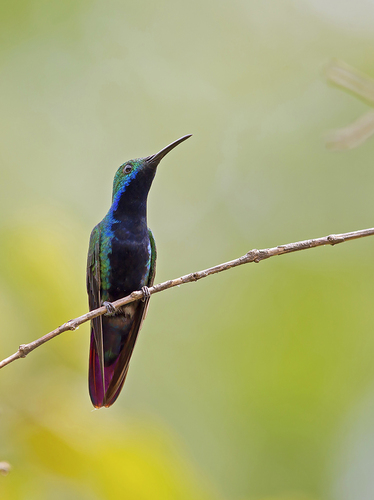
Black-throated Mango
Anthracothorax nigricollis
A shimmering gem of the Neotropics, the Black-throated Mango is a bold hummingbird known for its striking velvety plumage and fearless personality. Easily identified by its distinct black chest markings, it is a frequent and welcome visitor to backyard gardens across South America.
Quick Identification
Size
10.2 cm (4 in) in length; weighs approximately 7g (0.25 oz)
Colors
Iridescent green upperparts; males have velvety black throat and breast bordered by blue-green; females have white underparts with a wide black central stripe.
Key Features
- Broad velvety black patch on throat and chest (males)
- White underparts with a striking central black stripe (females)
- Long, slightly decurved black bill
- Dark purplish-red outer tail feathers
When You’ll See Them
Geographic range
Where Does the Black-throated Mango Live?
Native to the lush landscapes of Central and South America, the Black-throated Mango thrives across a vast territory starting from Panama and extending through nearly every mainland South American country, with the exception of Chile. It is a common resident throughout the tropical lowlands of Brazil, Colombia, and Venezuela, and is also widely spotted across the islands of Trinidad and Tobago. This bird's ability to adapt to various open environments has made it one of the most widely distributed hummingbirds in the Neotropics.
Basemap © OpenStreetMap contributors
Behavior
They are remarkable aerialists, capable of hovering with extreme precision to extract nectar or 'hawking' for small insects mid-air. While generally solitary, they are highly adaptable and have become a familiar sight in human-altered landscapes, readily visiting backyard gardens and artificial feeders where they often establish dominance over smaller species.
EverydayEarth exclusive
Camera Tips
Use a high-speed trigger setting if available, as their movements are incredibly fast. If you are using a feeder to attract them, place the camera approximately 3 to 4 feet away to ensure the bird fills the frame without triggering a 'fright' response. Setting your camera to burst mode is essential; you will likely need dozens of frames to get that one perfect shot of their wings in a graceful position or their tongue extended while feeding.
Since they are active throughout the day, ensure your camera is positioned to avoid direct backlight during peak feeding hours in the early morning and late afternoon. If your camera allows for video, try capturing at 60fps or higher to create beautiful slow-motion clips of their hovering behavior. In many parts of their range, these birds are year-round residents, so keeping your feeders clean and consistently full will help establish your backyard as a reliable territory for a local pair, providing endless photo opportunities.
Similar Species
Species that look similar or are commonly confused with Black-throated Mango.
Green-throated Mango
The Green-throated Mango male has a glittering green throat center, whereas the Black-throated male has a solid velvety black throat.
Green-breasted Mango
Found mostly in Mexico and Central America; the male has less extensive black on the chest compared to the Black-throated Mango.
Frequently Asked Questions
Record Black-throated Mango at your habitat
Connect a camera to start building your own species record — AI identifies every visitor automatically.