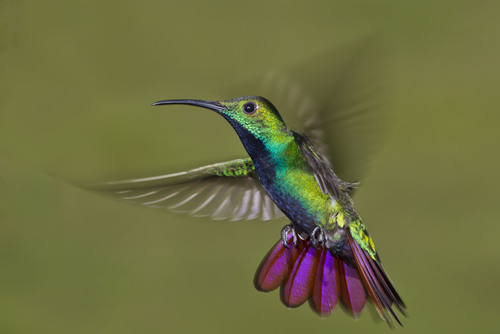
Green-breasted Mango
Anthracothorax prevostii
A large, stunning hummingbird of the tropics, the Green-breasted Mango is famous for its shimmering emerald plumage, its bold territorial displays, and its surprising appearances in backyards far north of its usual home.
Quick Identification
Size
Length 11–12 cm (4.3–4.7 in); weight 6.5–7.5 g (0.23–0.26 oz)
Colors
Males are deep iridescent green with a brilliant green throat and a dark belly. Females are white underneath with a distinctive dark-blue or black vertical stripe running down the center.
Key Features
- Relatively large, slightly decurved black bill
- Deep maroon or magenta outer tail feathers
- Dark vertical 'racing stripe' on white underparts of females
- Broad-winged, heavy-set appearance for a hummingbird
When You’ll See Them
Geographic range
Where Does the Green-breasted Mango Live?
Native to the tropical regions of North and Central America, the Green-breasted Mango thrives across a vast territory stretching from eastern Mexico through the Caribbean slopes of Central America down into northern Colombia and Venezuela. While it is primarily a tropical resident, it is famous among birders for its occasional appearances as a rare vagrant in the United States, particularly in southern Texas and even as far north as the Midwest. It is a lowland specialist, preferring coastal plains and foothills over high-altitude mountain ranges.
Basemap © OpenStreetMap contributors
Behavior
The Green-breasted Mango is a bold and conspicuous hummingbird often found in open landscapes rather than dense, dark forests. They are highly territorial, frequently seen perched high on exposed branches to survey their domain and aggressively defend prime nectar sources from other hummingbirds. While they exhibit the typical high-energy flight of their family, their larger size gives them a somewhat more deliberate and 'heavy' flight pattern compared to smaller, darting species.
In human-altered environments, they adapt remarkably well to gardens and plantations, often becoming the dominant visitors at bird feeders. Unlike some shy forest species, the Mango is relatively tolerant of human presence, provided there are plenty of flowering trees or shrubs nearby. They are known for their 'trap-lining' behavior, where they follow a consistent, daily route between various flowering plants to ensure a steady supply of nectar.
EverydayEarth exclusive
Camera Tips
Capturing the iridescent beauty of the Green-breasted Mango requires strategic placement near their favorite 'high-perch' spots. These birds love to sit on thin, exposed branches at the very top of a shrub or tree to monitor their territory. Mount your camera at eye level (approx. 5-6 feet) with a clear line of sight to these perches. Because they are territorial creatures of habit, once you find a perch they like, they are likely to return to it dozens of times throughout the day.
If you are using a nectar feeder to lure them for your AI camera, place the camera 3 to 5 feet away to capture the fine detail of their slightly curved bills and the female's unique vertical stripe. To catch the brilliant maroon of the tail feathers, try to angle the camera so the sun is behind the lens, illuminating the bird as it fans its tail while hovering. Early morning light is generally best to avoid the harsh shadows of the tropical sun which can wash out their emerald greens.
Since these birds move incredibly fast, use a high-speed trigger setting if your camera allows it. A 'burst' mode or high-frame-rate video is essential because the most dramatic shots—like the tail flare or the 'hawking' of an insect—happen in a fraction of a second. In backyard settings, planting native tubular flowers like Hibiscus or Bottlebrush is often more effective than feeders for encouraging long-term residency, as it provides both the nectar and the insect prey they need for protein.
Similar Species
Species that look similar or are commonly confused with Green-breasted Mango.
Black-throated Mango
The male has a much broader, solid black stripe down the center of the throat and chest compared to the Green-breasted's more emerald chest.
Ruby-throated Hummingbird
Much smaller with a perfectly straight bill; lacks the maroon tail feathers and the female's distinct vertical 'racing stripe' on the underparts.
Frequently Asked Questions
Record Green-breasted Mango at your habitat
Connect a camera to start building your own species record — AI identifies every visitor automatically.