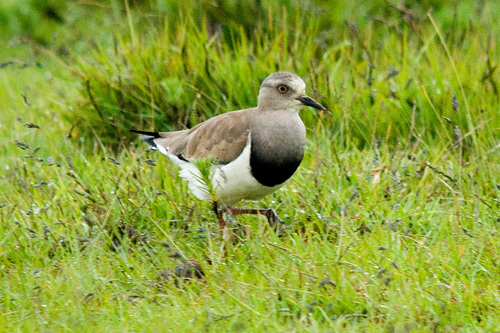
Black-winged Lapwing
Vanellus melanopterus
A social and elegant wader of the African plains, the Black-winged Lapwing is easily recognized by its bold black chest band and striking white forehead. It is a master of the short-grass highlands, often seen moving in synchronized flocks across well-watered lawns and pastures.
Quick Identification
Size
Length: 26-30 cm (10-12 in); Wingspan: 65-70 cm (25-27 in); Weight: 160-230 g (5.6-8.1 oz)
Colors
Ash-grey head with a distinct white forehead patch; dark brown upperparts; broad black band across the white breast; reddish-pink legs and a yellow eye-ring.
Key Features
- Prominent white patch on the forehead
- Broad black band across the upper chest
- Reddish-pink legs and pale yellow eye
- In flight, shows a white wing bar between black flight feathers
When You’ll See Them
Geographic range
Where Does the Black-winged Lapwing Live?
The Black-winged Lapwing is native to the African continent, where it maintains two geographically isolated populations. The northern population is concentrated in the Ethiopian highlands and reaches southward into central Kenya, while the southern population inhabits the middle-elevation and coastal grasslands of eastern South Africa. This species is a habitat specialist, following the rains across these highland and coastal plains to find the lush, short-cropped grass it requires for survival.
Basemap © OpenStreetMap contributors
Behavior
These birds are known for their nomadic tendencies, frequently moving locations at night to find optimal feeding grounds after rainfall or grass fires. In flight, their movements are synchronized and rapid, bearing a closer resemblance to smaller plovers than to the larger, more laboured flight of other lapwings. While they are cautious, they can adapt to human-altered landscapes like golf courses and airfields as long as the grass remains short and the area is well-watered.
EverydayEarth exclusive
Camera Tips
To successfully capture the Black-winged Lapwing on a trail camera, placement is everything. Because they are ground-dwellers that prefer wide-open spaces, you should mount your camera very low—ideally no more than 15 cm (6 inches) off the ground—using a stake or a low-profile ground mount. Position the camera to face a wide, flat expanse of short grass or a recently mowed area. Setting the camera at this 'eye-level' height will provide intimate, high-quality footage of their foraging behavior that a higher, downward-angled camera would miss.
Since this species is known to move and forage at night, ensure your camera is equipped with a high-quality infrared flash. Using a 'No-Glow' or 'Black LED' flash is highly recommended to avoid spooking these naturally shy birds. If you have a birdbath or a shallow water feature in an open area, point your camera there; although they are grassland specialists, they are attracted to water for drinking and bathing, especially during the drier months. A small patch of bare, moist earth can also act as a natural lure for the insects they hunt.
For the best results, use a 'Photo Burst' or 'Multi-Shot' setting. Black-winged Lapwings often travel in groups, and a single trigger might miss the majority of the flock as they walk past. Setting the camera to take 3 to 5 photos per trigger ensures you capture the social dynamics of the group. Additionally, because they are quick runners, a fast trigger speed (0.3 seconds or less) and a high shutter speed are necessary to prevent motion blur during their active foraging sessions.
Similar Species
Species that look similar or are commonly confused with Black-winged Lapwing.
Frequently Asked Questions
Record Black-winged Lapwing at your habitat
Connect a camera to start building your own species record — AI identifies every visitor automatically.