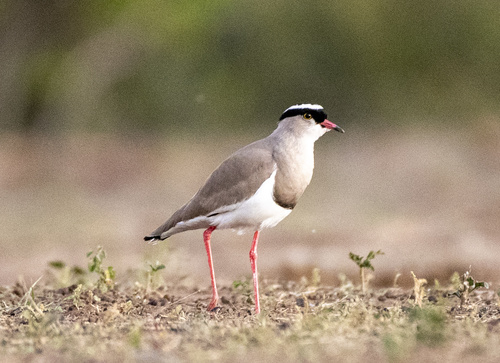
Crowned Lapwing
Vanellus coronatus
The bold sentinel of the African plains, the Crowned Lapwing is instantly recognizable by its striking 'halo' crown and its loud, fearless personality.
Quick Identification
Size
30-32 cm (12-13 in) in length; wingspan of 75-85 cm (29-33 in); weighs 160-200g (5.6-7 oz)
Colors
Sandy-brown back and breast; white underparts; distinctive black crown with a circular white band; bright red legs and a red bill with a black tip.
Key Features
- Distinctive white 'halo' ring on a black crown
- Long, bright red or pinkish legs
- Noisy, piercing alarm calls
- Sharp contrast between brown breast and white belly
- Red bill with a black tip
When You’ll See Them
Sightings on EverydayEarth
Jul 4, 2026
A crash of White Rhinoceroses is gathered in a dry woodland clearing. Some of the rhinos are slowly walking across the scene while others stand together in a group. Several small Red-billed Oxpeckers are perched on their backs and flanks. In the foreground, a Crowned Lapwing is seen walking across the dusty ground, pausing occasionally to look around.
Jul 3, 2026
A Crowned Lapwing is active at the edge of the water hole. It moves along the muddy bank, occasionally pausing to forage or scan its surroundings in the bright morning light.
Jul 3, 2026
A Crowned Lapwing stands alert on the left bank of the watering hole. It remains mostly stationary throughout the sequence, occasionally turning its head to scan the surroundings in the bright morning light.
Jun 20, 2026
Several white rhinoceroses are resting in an enclosure, with most lying down on the ground while one remains standing near the trees. A crowned lapwing is active on the ground, walking and foraging between the large resting mammals.
Jun 19, 2026
A Scrub Hare is resting quietly in the background of a woodland clearing at night. In the foreground, a Crowned Lapwing is active, foraging on the ground with characteristic pecking motions.
May 28, 2026
Three birds are visible during the night. Two stand in the background near the water's edge, while a third Crowned Lapwing walks into the foreground from the left, pauses to look around, and then stands still, showcasing its characteristic head markings.
Geographic range
Where Does the Crowned Lapwing Live?
This resilient bird is native to the African continent, stretching from the Red Sea coast in Somalia and Ethiopia through East Africa down to South Africa. It is a common sight across the Highveld of South Africa, the plains of Botswana, and the savannas of Kenya and Tanzania. Because they prefer short-grass habitats, they have successfully moved into suburban areas where human landscaping provides the perfect open foraging grounds.
Basemap © OpenStreetMap contributors
Behavior
The Crowned Lapwing is one of Africa’s most charismatic and audible birds, often acting as a self-appointed 'sentinel' for the grasslands. They are famous for their bold and aggressive nature, particularly during the breeding season when they will dive-bomb intruders—including humans and large predators—that venture too close to their ground nests. Their name comes from the striking black and white pattern on their heads, which looks like a regal crown from above.
Unlike many other waders, Crowned Lapwings have adapted exceptionally well to human presence. They are highly social birds, often found in pairs or small family groups. They spend much of their time on the ground, using a characteristic 'run-and-stop' motion to hunt for prey. While they are active during the day, they are also notably crepuscular and nocturnal, often seen and heard moving under the light of a full moon.
EverydayEarth exclusive
Camera Tips
To capture the best footage of a Crowned Lapwing on your trail camera, you need to think low. These birds are terrestrial specialists, so mounting your camera just 6 to 12 inches off the ground is ideal. Aim the lens across a flat, open area of your lawn or a nearby patch of short grass. Avoid tall grass, as the lapwing’s legs will be obscured and the motion sensor may be triggered by wind-blown vegetation instead of the bird.
Because Crowned Lapwings are active during the twilight hours and even at night, a camera with high-quality 'no-glow' or low-glow infrared LEDs is essential. This allows you to see their nocturnal foraging habits without startling them with a bright white flash. Set your camera to take short video clips (10-15 seconds) or rapid-fire bursts, as these birds move in quick, jerky sprints that can be difficult to capture in a single still photo.
While they don't visit traditional seed feeders, you can attract them naturally by keeping a patch of your lawn mown very short. This mimics the burnt veld or grazed plains they naturally prefer. Providing a shallow, ground-level birdbath or water tray can also entice them to stop and stay within the camera's field of view for longer periods. During the nesting season, look for them in open areas where they lay eggs directly on the ground; placing a camera 15-20 feet away from a known nesting site (without disturbing it) can provide incredible footage of their protective behaviors.
Similar Species
Species that look similar or are commonly confused with Crowned Lapwing.
Frequently Asked Questions
Record Crowned Lapwing at your habitat
Connect a camera to start building your own species record — AI identifies every visitor automatically.