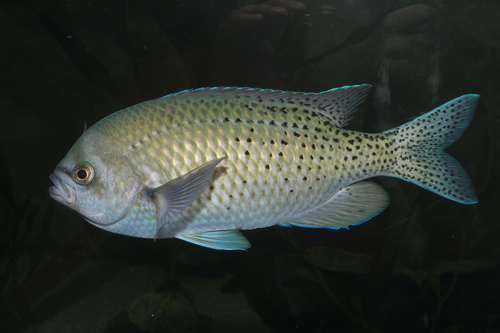
Blacksmith Chromis
Chromis punctipinnis
A staple of the California coastline, the Blacksmith Chromis is a shimmering, spotted marvel that brings the kelp forest to life with its massive schools and unique 'cleaning' rituals.
Quick Identification
Size
Typically 15-30 cm (6-12 inches) in length
Colors
Adults are dark blue-gray to charcoal with black spots on the rear half of the body and fins; juveniles are bi-colored with blue-gray fronts and yellow-orange rears.
Key Features
- Deep, oval-shaped body profile
- Distinctive small black spots on the posterior dorsal and tail fins
- Protrusible mouth adapted for plankton feeding
- Highly social, often found in large, shimmering schools
When You’ll See Them
Sightings on EverydayEarth
Jul 30, 2026
A vibrant underwater scene shows several fish species active around large pier pilings. Bright orange Garibaldi swim prominently between the columns, while schools of small, dark Blacksmith Chromis dart through the open water. A mottled Kelp Bass is also visible cruising through the lower portion of the frame.
Jul 30, 2026
A school of Blacksmith Chromis swims through the underwater pilings of a pier. The fish move gracefully through the clear blue water, displaying purposeful swimming and schooling behavior as they navigate between the algae-covered structures.
Jul 29, 2026
Several Blacksmith Chromis swim among large, algae-covered underwater pilings. One individual is seen clearly in the lower foreground, swimming from right to left, while several others dart through the sun-dappled water in the background.
Jul 26, 2026
A vibrant underwater scene showing a variety of fish swimming among barnacle-encrusted pier pilings. Several Kelp Bass cruise near the structures, while bright orange Garibaldi and a large male California Sheephead move through the background. Schools of small, dark Blacksmith are scattered throughout the water column.
Jul 25, 2026
A diverse community of temperate reef fish swims among large, encrusted pier pilings. A large California Sheephead and several bright orange Garibaldi are prominent as they navigate the water column, while schools of Blacksmith and individual Kelp Bass drift in the background and between the structures.
Jul 25, 2026
A vibrant orange Garibaldi swims through the center of the frame, navigating between large pier pilings. In the background, a large school of small, dark Blacksmith Chromis drifts in the current. A male California Sheephead briefly enters and exits the frame on the left side.
Geographic range
Where Does the Blacksmith Chromis Live?
The Blacksmith Chromis is a native resident of the subtropical northeastern Pacific Ocean. Its distribution is concentrated along the coast of North America, stretching from the relatively cool waters of Monterey Bay in California down to the warmer coastal regions of central Baja California, Mexico. They are particularly abundant around the Channel Islands and the Southern California Bight, where rocky underwater topography provides ample nesting and hiding spots.
Basemap © OpenStreetMap contributors
Behavior
One of their most fascinating behaviors is their relationship with 'cleaner' species like the Senorita fish. When a Blacksmith feels the need for a grooming session to remove parasites, it will tilt its body vertically—either head-up or head-down—and remain perfectly still. This signal invites cleaner fish to pick over its scales. At night, the social structure dissolves as individuals retreat into the safety of rocky crevices and holes to sleep, protected from nocturnal predators like seals and larger fish.
EverydayEarth exclusive
Camera Tips
Lighting is the biggest challenge when using AI cameras underwater. For the most vibrant blue-gray tones, schedule your recording or set your AI triggers for midday (10 AM to 2 PM) when the sun is highest. This allows light to penetrate the kelp canopy, reducing the 'green' cast and highlighting the iridescent quality of their scales. If you are using a camera with motion-sensing AI, set the sensitivity high, as the swaying movement of kelp can sometimes mask the subtler movements of the fish school.
While Blacksmiths aren't attracted to traditional 'backyard' birdseed, they are curious. If you are filming from a dock or pier, you can occasionally draw them into the camera's field of view by disturbing the water or introducing small amounts of pulverized fish food, though they are much more likely to visit a site that features a 'cleaning station'—a specific rock or patch of kelp where Senorita fish are known to congregate. Ensure your camera is set to a high frame rate (at least 60fps) to capture their quick, snapping feeding motions clearly.
Similar Species
Species that look similar or are commonly confused with Blacksmith Chromis.
Frequently Asked Questions
Record Blacksmith Chromis at your habitat
Connect a camera to start building your own species record — AI identifies every visitor automatically.