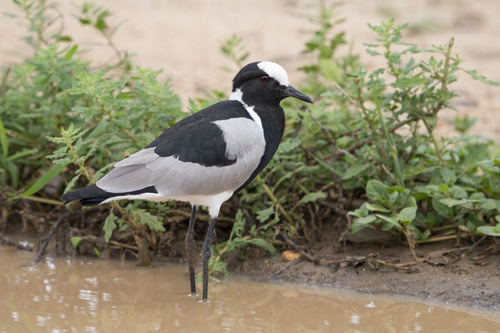
Blacksmith Lapwing
Vanellus armatus
Named for its metallic call that sounds like a hammer striking an anvil, the Blacksmith Lapwing is the bold, monochrome guardian of African waterways and suburban lawns.
Quick Identification
Size
28–31 cm (11–12 inches) in length; wingspan approximately 75–80 cm (30 inches); weight 230–330 g (8–12 oz)
Colors
Bold contrast of black, white, and grey. Black crown, chest, and tail; white forehead and back of neck; grey wings and back. Males and females are identical in appearance.
Key Features
- Striking monochrome black-and-white facial pattern
- Piercing red eyes
- Long, spindly dark legs
- Sharp carpal spurs on the wrists of the wings
- Distinctive metallic 'tink-tink' alarm call
When You’ll See Them
Sightings on EverydayEarth
Jul 29, 2026
A single Blacksmith Lapwing is standing on the muddy bank of a watering hole. The bird remains largely stationary, occasionally shifting its weight and turning its head to scan the surrounding woodland environment.
Jul 29, 2026
Two Blacksmith Lapwings are foraging in a shallow waterhole. One bird stands near the center of the pool, periodically turning its head and wading through the water, while the second bird is visible near the right edge of the bank.
Jul 28, 2026
A single Blacksmith Lapwing is visible on the left bank of the water hole, foraging in the mud. The bird moves slowly along the shoreline, occasionally pausing to look for food in the dry winter landscape.
Jul 27, 2026
Two Blacksmith Lapwings are standing at the edge of a still waterhole at night. The birds remain mostly stationary, though one can be seen turning its head slightly to observe the surroundings.
Jul 27, 2026
Two Blacksmith Lapwings are stationed at the water's edge during the night. One of the birds is seen vocalizing, tilting its head back and moving its throat in a calling display, while the other remains quietly perched nearby.
Jul 26, 2026
Under the cover of darkness, two Blacksmith Lapwings are active on the far side of the watering hole. They are seen walking along the grassy bank, their movements purposeful as they forage near the water's edge. Faint mist rises from the surface of the pond.
Geographic range
Where Does the Blacksmith Lapwing Live?
Native to the African continent, the Blacksmith Lapwing is a widespread and common resident across Southern and East Africa. Its core range stretches from Kenya and central Tanzania down through countries like Namibia, Botswana, Zimbabwe, and South Africa. While traditionally a wetland specialist, the species has significantly expanded its range in recent decades by moving into man-made landscapes such as irrigated farmland and urban green spaces.
Basemap © OpenStreetMap contributors
Behavior
The Blacksmith Lapwing is a bold and charismatic wader known for its fearless temperament. They are highly territorial, especially during the breeding season, when they will aggressively defend their ground-level nests from intruders. They are famous for their 'dive-bombing' tactics, swooping low over the heads of humans or predators while emitting their signature metallic clinking sound to drive them away.
These birds are quite social outside of the breeding season, often gathering in loose flocks near water sources. They exhibit a 'run-and-pause' foraging style, darting across the grass or mud to snatch up prey. Unlike many other lapwings, they are also notably active during the night, particularly during moonlit periods, when their calls can often be heard echoing across suburban neighborhoods and wetlands.
EverydayEarth exclusive
Camera Tips
To capture the Blacksmith Lapwing on camera, placement is everything. Since these birds are ground-dwellers that prefer open spaces, position your camera low to the ground—ideally just 10 to 20 centimeters high. Aim the lens toward the edge of a pond, a shallow birdbath, or a damp patch of lawn where they frequently forage for insects. A wide-angle lens is perfect for capturing their striking 'wing-stretching' displays or aggressive territorial stances.
Because they are active during both day and night, ensure your camera has a high-quality infrared flash for clear nighttime captures. They are particularly active during full moons, so this is the best time to check your triggers. For daytime shots, use a fast shutter speed; these birds move in quick, jerky bursts and you’ll want to freeze that motion to see the detail in their monochrome feathers and bright red eyes.
While you don't need traditional bait, keeping a well-watered lawn or a shallow, muddy puddle in the camera's field of view acts as a natural lure. They are attracted to the insects that thrive in damp soil. If you are lucky enough to have a nesting pair nearby, place the camera at a respectful distance (at least 10-15 meters) facing the general area; they are extremely predictable in their flight paths when returning to a nest scrape.
Similar Species
Species that look similar or are commonly confused with Blacksmith Lapwing.
Frequently Asked Questions
Record Blacksmith Lapwing at your habitat
Connect a camera to start building your own species record — AI identifies every visitor automatically.