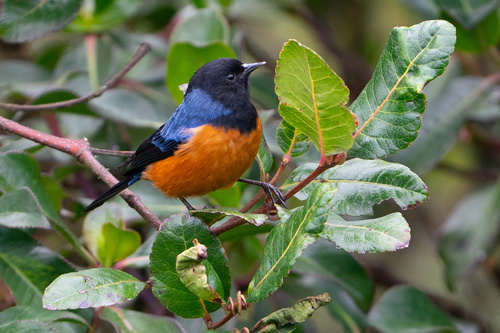
Blue-backed Conebill
Conirostrum sitticolor
A gem of the Andean peaks, the Blue-backed Conebill is a master of acrobatic foraging, draped in stunning sapphire and chestnut plumage.
Quick Identification
Size
Length: 12-13 cm (4.7-5.1 in); Weight: 11-15 g (0.4-0.5 oz)
Colors
Deep blue back and wings, black head and throat, and rich chestnut-rufous underparts; sexes are similar in appearance.
Key Features
- Distinctive black hood contrasting with a deep blue back
- Rich rufous-chestnut belly and breast
- Fine, sharply pointed black bill
- Acrobatic foraging style, often hanging upside down
When You’ll See Them
Geographic range
Where Does the Blue-backed Conebill Live?
The Blue-backed Conebill is a quintessential South American highland specialist, exclusively found along the massive corridor of the Andes Mountains. Its native range forms a long, narrow ribbon stretching from the coastal mountains of northern Venezuela through the central cordilleras of Colombia, Ecuador, and Peru, finally reaching its southern limit in the yungas of Bolivia. These birds are strict residents of these high-elevation environments and are not known to have been introduced anywhere outside their native montane ecosystems.
Basemap © OpenStreetMap contributors
Behavior
The Blue-backed Conebill is a restless and energetic inhabitant of the high Andes. Unlike many shy forest birds, this species is known for its active and visible foraging style. It is a quintessential member of mixed-species flocks, often seen traveling alongside flowerpiercers, tanagers, and wood-warblers as they move through the canopy and sub-canopy of misty cloud forests.
Its movement is notably acrobatic; it frequently clings to the undersides of branches or investigates clumps of moss and epiphytes, much like a nuthatch or a tit. While they are primarily social birds within their flocks, they can be territorial during the breeding season. They generally show little fear of humans, particularly in areas where eco-tourism and bird feeding stations are established, making them a delight for backyard observers in high-altitude regions.
EverydayEarth exclusive
Camera Tips
To capture the Blue-backed Conebill on a trail camera, you must focus on height. These birds rarely descend to the ground, preferring the mid-story and canopy. If you have a backyard at high elevation, mount your camera 2 to 3 metres (6 to 10 feet) high, angled toward clusters of epiphytes, mossy branches, or flowering bushes like Fuchsia or Brachyotum, which provide the nectar and insects they crave.
Because they are small and move with sudden, jerky motions, use a camera with a very fast trigger speed (0.2 seconds or less) and set it to take a burst of 3-5 photos. This increases your chances of getting a sharp image rather than a blue blur. High-speed video (60 fps) is also excellent for capturing their acrobatic 'hanging' behavior as they probe for food.
If you use feeders, place your camera near a hummingbird feeder or a specialized nectar feeder. While they are not primary nectar feeders like hummingbirds, they are frequent 'robbers' and will visit these stations regularly. Early morning light is the best for bringing out the deep sapphire tones of their feathers; try to position the camera with the sun at its back to avoid silouttes against the bright mountain sky.
Similar Species
Species that look similar or are commonly confused with Blue-backed Conebill.
Capped Conebill
Smaller with a distinct black cap rather than a full hood, and paler cinnamon underparts.
Blue-and-black Tanager
Lacks the chestnut belly; instead, it is primarily bright blue and black throughout.
Pearled Treerunner
Similar foraging style on bark, but has a spotted/pearled appearance and lacks the bold blue and chestnut color block.
Frequently Asked Questions
Record Blue-backed Conebill at your habitat
Connect a camera to start building your own species record — AI identifies every visitor automatically.