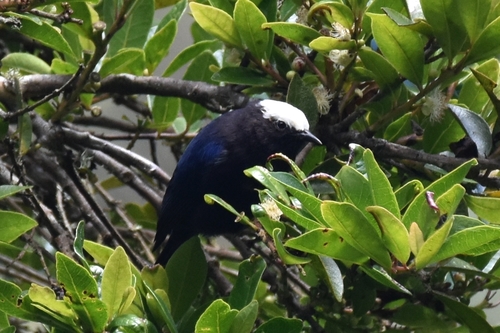
Capped Conebill
Conirostrum albifrons
With its striking white crown and restless energy, the Capped Conebill is a jewel of the Andean cloud forest. This high-altitude specialist brings a flash of contrast to the misty highlands of South America.
Quick Identification
Size
Length of 4.7 to 5.1 inches (12-13 cm); weight approximately 0.35 to 0.45 oz (10-13 g)
Colors
Males are deep velvety blue-black with a brilliant white crown; females are olive-green above, yellowish-buff below, with a greyish-blue crown.
Key Features
- Bright white crown on males
- Short, sharply pointed conical bill
- Vibrant olive-green and yellow tones in females
- Highly active, acrobatic foraging behavior
When You’ll See Them
Geographic range
Where Does the Capped Conebill Live?
Native to the South American continent, the Capped Conebill is a specialist of the Andean mountain chain. Its range forms a continuous corridor from the coastal mountains of northern Venezuela through the central and eastern cordilleras of Colombia and Ecuador, extending south through Peru and into the yungas of western Bolivia. It is strictly a resident species, remaining in these high-altitude tropical and subtropical zones throughout the year.
Basemap © OpenStreetMap contributors
Behavior
The Capped Conebill is a remarkably high-energy songbird, characteristic of the misty, moss-laden forests of the Andes. These birds are rarely seen alone; they are quintessential socialites, almost always participating in large, mixed-species foraging flocks alongside tanagers, warblers, and flowerpiercers. They move through the sub-canopy and canopy with restless agility, constantly flitting from branch to branch in search of food.
While they are not particularly shy around humans, their preference for high-altitude forest interiors means they are most often encountered by hikers and birdwatchers in protected cloud forest reserves. They exhibit a unique foraging style, frequently hanging upside down or reaching at awkward angles to probe bromeliads and moss clumps for hidden prey. Their vocalizations are relatively high-pitched and thin, often lost in the wind of the high Andes but essential for keeping the flock together.
EverydayEarth exclusive
Camera Tips
Capturing the Capped Conebill on camera requires an understanding of their vertical preference. These birds generally stay in the mid-to-upper canopy, so your best chance for a clear shot is placing cameras on sloping terrain where the camera can look horizontally into the treetops of trees growing further down the slope. If you are near a mountain lodge or a high-altitude garden, look for moss-covered branches or flowering shrubs like Fuchsia, which can draw them down to eye level.
Because these birds are extremely fast and rarely sit still for more than a second, use the fastest trigger speed your camera allows. A 'Burst Mode' or high-speed multi-shot setting is essential to catch a sharp frame amidst their constant movement. If your camera allows for video, a high frame rate (60fps or higher) will help you slow down their rapid-fire foraging motions in post-production.
Cloud forests are notoriously dim environments. To avoid grainy or blurry images, position your camera in areas where the canopy opens up slightly to allow for natural light. If using a flash, ensure it is a subtle fill-flash; otherwise, the bright white crown of the male will 'blow out' and lose all detail in the digital file. Avoid using heavy baits; instead, focus your lens on natural 'choke points' like a narrow mossy bridge between two large trees.
Similar Species
Species that look similar or are commonly confused with Capped Conebill.
Frequently Asked Questions
Record Capped Conebill at your habitat
Connect a camera to start building your own species record — AI identifies every visitor automatically.