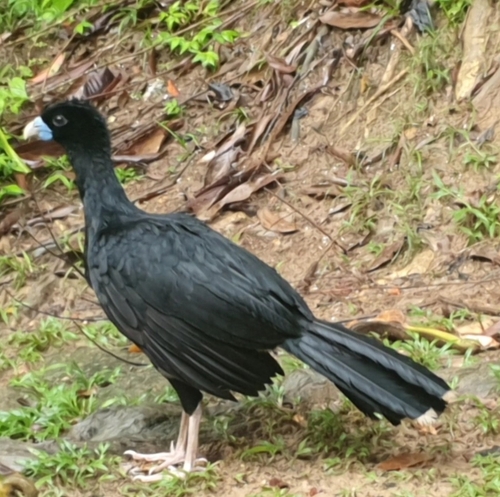
Blue-billed Curassow
Crax alberti
The Blue-billed Curassow is one of the world's rarest birds, a 'ghost of the forest' endemic only to Colombia. With its striking cerulean bill and regal crest, this critically endangered bird is a prize for any wildlife observer.
Quick Identification
Size
Length: 82–92 cm (32–36 in); Weight: 3.2–3.6 kg (7–8 lbs)
Colors
Males are glossy black with a white vent and a striking sky-blue bill base; females are black with white barring on wings and a reddish-brown belly.
Key Features
- Distinctive sky-blue fleshy cere and wattles on the bill
- Prominent forward-curling crest of black feathers
- Large, turkey-like body with long, sturdy legs
- Females feature intricate white-and-black barring on wings and tail
When You’ll See Them
Geographic range
Where Does the Blue-billed Curassow Live?
Native exclusively to South America, the Blue-billed Curassow is a rare endemic found only in Colombia. Its current range is restricted to small, fragmented pockets of humid forest in the Magdalena River valley and the northern foothills of the Sierra Nevada de Santa Marta. Once widespread across northern Colombia, habitat loss has pushed this species into just a few protected reserves and isolated forest remnants.
Basemap © OpenStreetMap contributors
Behavior
The Blue-billed Curassow is a largely terrestrial bird, spending the majority of its day patrolling the forest floor with a slow, deliberate gait. They are incredibly shy and wary of human presence, often disappearing into dense undergrowth at the slightest hint of danger. Despite their ground-dwelling nature, they are capable fliers and will retreat into the canopy to roost at night or to escape predators.
Socially, they are typically found in pairs or small family units, maintaining a monogamous breeding system. During the breeding season, males perform a remarkable display that involves a deep, low-frequency 'booming' vocalization that can resonate through the humid forest air. They are vital to their ecosystem as seed dispersers, helping to maintain the diversity of the tropical forests they inhabit.
EverydayEarth exclusive
Camera Tips
Capturing the Blue-billed Curassow on camera requires extreme patience and a deep understanding of their terrestrial habits. Position your camera very low to the ground—roughly 18 to 24 inches high—to get an eye-level perspective of these magnificent birds. Focus on established game trails or 'corridors' within dense forest where the leaf litter appears disturbed, as these birds often follow the same paths daily while foraging.
Because they are highly sensitive to artificial light and human scents, it is essential to use a 'no-glow' or black-LED infrared flash to avoid spooking them during early morning or late afternoon movements. Scent control is equally important; wear gloves when handling your camera and try to minimize the time spent in the immediate area. They are most likely to be caught on camera near natural water sources or under fruiting trees such as wild figs or palms during the peak of the rainy season.
Set your camera to a fast trigger speed and use the 'Burst' or 'Multi-shot' setting. These birds move with a rhythmic, bobbing walk, and having a sequence of photos ensures you capture the perfect profile of their unique blue bill and curly crest. If your camera supports high-quality video with audio, that is often the best way to record their deep, resonant booming calls, which are among the most unique sounds in the Colombian rainforest.
Similar Species
Species that look similar or are commonly confused with Blue-billed Curassow.
Frequently Asked Questions
Record Blue-billed Curassow at your habitat
Connect a camera to start building your own species record — AI identifies every visitor automatically.