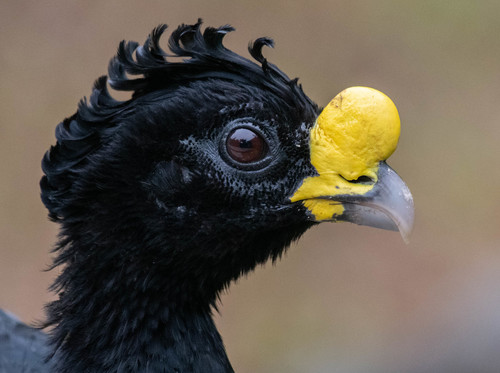
Great Curassow
Crax rubra
With its magnificent curly crest and striking yellow bill, the Great Curassow is a regal ghost of the Neotropical rainforest floor. Once widespread, this vulnerable giant is now a prized sight for wildlife photographers and backyard observers in Central America.
Quick Identification
Size
Length 31-39 inches (78-100 cm); Weight 6.8-10.6 lbs (3.1-4.8 kg)
Colors
Males are glossy black with white bellies and bright yellow bill knobs; females vary from rufous-brown to barred black and white.
Key Features
- Distinctive curly crest of feathers on the head
- Large, turkey-sized body with a long tail
- Bright yellow fleshy knob at the base of the male's bill
- Broad, rounded wings adapted for short bursts of flight
When You’ll See Them
Geographic range
Where Does the Great Curassow Live?
Native to the Neotropical regions of the Americas, the Great Curassow's range stretches from the lush eastern rainforests of Mexico through the dense corridors of Central America into western Colombia and northwestern Ecuador. These birds are lowland specialists, thriving in undisturbed primary forests and mangroves across countries like Costa Rica, Panama, and Guatemala. While they were once widespread, their presence today is often restricted to protected national parks and remote wilderness areas where habitat loss and hunting are minimized.
Basemap © OpenStreetMap contributors
Behavior
Great Curassows are primarily terrestrial foragers that spend their days walking the forest floor in small groups or pairs. Despite their heavy, turkey-like build, they are surprisingly agile and will fly into the mid-canopy to escape predators or to find a safe place to roost for the night. They are known for their monogamous breeding habits, with pairs often staying together and the male taking a leading role in nest construction, which is unusually small for such a large bird.
Interaction with humans varies significantly depending on the environment. In areas where they are hunted, they are incredibly shy and disappear at the first sign of movement. However, in protected reserves or eco-lodges, they can become quite habituated to human presence, often strolling through clearings with a regal, slow-motion gait. Their vocalizations are a key part of their social structure, particularly the male's low-frequency booming call which can travel long distances through the dense tropical undergrowth.
EverydayEarth exclusive
Camera Tips
To capture the Great Curassow on camera, placement is everything. Since they are primarily ground-foragers, position your camera low to the ground—about 18 to 24 inches (45-60 cm) high—and angled slightly upward. Focus on natural 'highways' like game trails or clearings near the base of large fruiting trees, such as wild figs or palms, as these birds spend hours vacuuming up fallen fruit. Because they are large birds, ensure the camera has a wide enough field of view to capture the whole bird without cutting off that iconic curly crest.
Timing is crucial for this species. They are most active in the early morning and late afternoon when they descend from their tree-top roosts to feed. Setting your camera's trigger speed to its fastest setting is beneficial; while they walk slowly, they can be surprisingly skittish. If you are in a backyard setting near a forest edge, providing a consistent source of fallen fruit or a large, shallow ground-level water feature can serve as a natural lure that keeps them in the frame longer.
High-resolution video settings are highly recommended for the Great Curassow, as their low-frequency booming calls are just as impressive as their visual appearance. If your camera supports audio recording, it may pick up the male’s deep 'ommmm' sound, which is often the first sign that one is nearby even before it enters the frame. Avoid using bright white flashes at night if you are near a roosting tree, as this can startle them and cause them to abandon the site; instead, rely on high-quality infrared sensors.
Similar Species
Species that look similar or are commonly confused with Great Curassow.
Frequently Asked Questions
Record Great Curassow at your habitat
Connect a camera to start building your own species record — AI identifies every visitor automatically.