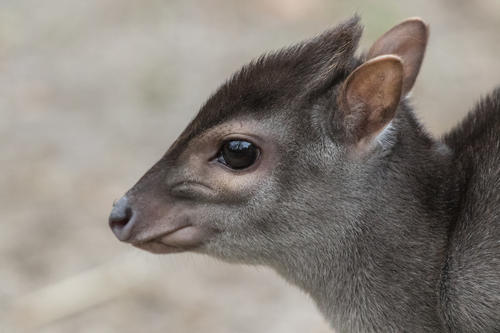
Blue Duiker
Philantomba monticola
Meet the blue duiker, Africa's smallest and most enchanting forest antelope. These tiny, 'blue-tinted' gems are known for their shy nature and incredible agility within the dense undergrowth of the continent’s coastal and montane forests.
Quick Identification
Size
Shoulder height 32–41 cm (13–16 in); weight 3.5–9 kg (7.7–19.8 lb)
Colors
Slate-blue to grayish-brown glossy coat; white underbelly; dark tail with white underside fringe; females are typically larger than males
Key Features
- Diminutive size, the smallest of all duikers
- Prominent scent gland slits below the eyes
- Short, spiky 5cm horns often hidden by hair tufts
- Arched back with hindquarters higher than the shoulders
When You’ll See Them
Geographic range
Where Does the Blue Duiker Live?
The blue duiker is a quintessential African forest dweller, occupying a wide geographical belt across the central, eastern, and southern regions of the continent. Its range stretches from the lush Atlantic coast of Nigeria and Gabon, through the vast Congo Basin, and down into the subtropical coastal forests of South Africa. You can also find them in the high-altitude montane forests of Kenya and Tanzania, making them one of the most widely distributed small bovids in Sub-Saharan Africa.
Basemap © OpenStreetMap contributors
Behavior
The blue duiker is a highly secretive and cautious creature, spending most of its life within the safety of dense undergrowth. Unlike many other antelope, they form stable, monogamous pairs that defend a small territory together. They are famous for their 'flicking' tail movement, which exposes the white underside as a signal to their mate or as a distraction to predators. While they can be active at any time, they are most frequently observed during the twilight hours of dawn and dusk.
In areas near human settlements, they become almost entirely nocturnal to avoid detection. They rely heavily on scent marking, using the large preorbital glands beneath their eyes to rub secretions onto branches and twigs to define their home range. Their social structure is rigid, and they will vigorously chase away intruders of the same sex to protect their feeding grounds.
EverydayEarth exclusive
Camera Tips
Capturing the blue duiker on camera requires a low-profile approach because of their tiny stature. You should mount your camera no higher than 12 to 18 inches (30–45 cm) off the ground. If the camera is mounted at standard human waist height, you will likely only capture the top of the animal's head or miss it entirely as it moves through the leaf litter. Angle the lens slightly upward if you are placing it on a slope to ensure the full body is in the frame.
Location is everything for this species. Look for established 'runways'—tiny, cleared paths through dense ferns or brush—as blue duikers are creatures of habit and use the same trails daily. Placing your camera near a fruiting tree (like a wild fig or milkwood) is the gold standard for success. They spend significant time lingering under these trees waiting for monkeys or birds to drop food, giving you the perfect opportunity for a still, clear shot rather than a blurred motion photo.
Because they are extremely skittish, use a camera with a high-speed trigger (0.3 seconds or less) and a 'No-Glow' infrared flash. Standard red-glow LEDs can spook them, causing them to bolt before the second or third photo in a burst is taken. If your camera allows for video, set it to 15-second clips; watching their constant tail-flicking and scent-marking behavior is far more rewarding than a static image.
In backyard settings that border natural bush, you can attract them by providing fallen fruit like apples or plums, but be aware that they are sensitive to human scent. Keep your camera checks infrequent—once every two weeks is plenty—to avoid making the area feel unsafe for these shy little antelopes.
Similar Species
Species that look similar or are commonly confused with Blue Duiker.
Frequently Asked Questions
Record Blue Duiker at your habitat
Connect a camera to start building your own species record — AI identifies every visitor automatically.