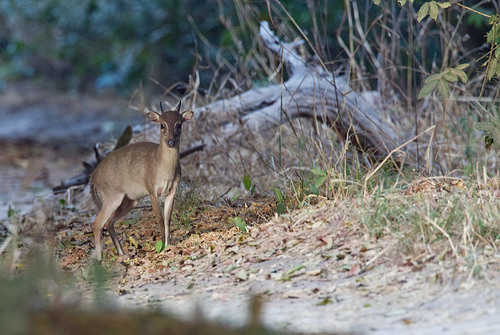
Maxwell's Duiker
Philantomba maxwellii
A secretive and graceful inhabitant of West Africa's dense rainforests, the Maxwell's Duiker is a master of the undergrowth. This small, slate-grey antelope is most famous for its arched back and its unique habit of 'diving' into thickets when startled.
Quick Identification
Size
Length 63–100 cm (25–39 in); Shoulder height 35–42 cm (14–16.5 in); Weight 4–10 kg (9–22 lbs)
Colors
Uniform greyish-brown to slate-grey upper body; whitish or pale grey belly; dark tail with white edges and a distinctive fringe of hair.
Key Features
- Distinctive preorbital gland slits below eyes
- Highly arched back with shorter front legs than hind legs
- Small, straight, spiked horns often hidden by hair tuft
- Small, rounded ears with white interior markings
When You’ll See Them
Geographic range
Where Does the Maxwell's Duiker Live?
The Maxwell's Duiker is a native inhabitant of the lush forest blocks of West Africa. Its primary range stretches from southwestern Senegal and The Gambia eastward through Guinea, Sierra Leone, Liberia, and Côte d'Ivoire, reaching its eastern limit at the Volta River in Ghana. It is a true specialist of the Upper Guinean forest, where it thrives in moist lowland environments and riverine thickets that offer dense cover from predators.
Basemap © OpenStreetMap contributors
Behavior
Maxwell's Duikers are highly territorial creatures that rely heavily on scent marking to define their personal space. They possess large preorbital glands under their eyes, which they rub against twigs, branches, and even their mates to leave a chemical signature. While they are often described as shy and secretive, they are remarkably social within their pair bonds, frequently engaging in mutual grooming and a unique 'head-pressing' behavior to reinforce social ties.
In terms of daily activity, these small antelopes are cathemeral, meaning they are active intermittently throughout both the day and night. However, in areas with significant human activity or hunting pressure, they quickly shift toward more nocturnal patterns to remain undetected. They move with a characteristic 'duiking' or diving motion through thick undergrowth, which is how they earned their common name from the Afrikaans word 'duiker' (diver).
EverydayEarth exclusive
Camera Tips
To successfully capture a Maxwell's Duiker on camera, you must account for their small size and ground-dwelling habits. Set your camera at a 'knee-high' level—approximately 12 to 18 inches (30–45 cm) off the ground. This low placement provides an intimate, eye-level perspective of the animal and ensures you don't miss them under a wider, higher-angle shot designed for larger mammals.
The best locations for camera placement are 'fruiting hotspots.' Identify trees that are currently dropping ripe fruit, such as wild figs or oil palms, as duikers will visit these spots repeatedly. Because they are naturally skittish and sensitive to light, it is highly recommended to use 'No-Glow' or 'Black Flash' infrared cameras. White flash can spook them instantly, causing them to abandon the area for days.
Look for 'tunnels' in the dense undergrowth. These are established game trails used by small mammals to move through the forest safely. If you place your camera along these trails, set the trigger speed to its fastest setting; duikers are remarkably quick and can dart through the frame in a fraction of a second. Using video mode for 10-15 seconds can often reveal fascinating social behaviors like scent marking that a still photo might miss.
Similar Species
Species that look similar or are commonly confused with Maxwell's Duiker.
Frequently Asked Questions
Record Maxwell's Duiker at your habitat
Connect a camera to start building your own species record — AI identifies every visitor automatically.