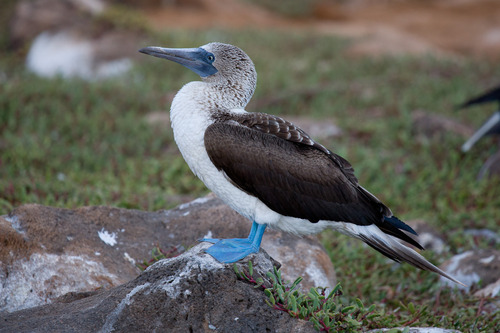
Blue-footed Booby
Sula nebouxii
The Blue-footed Booby is nature's most colorful dancer, sporting brilliant turquoise footwear and performing high-stepping rituals on the rocky shores of the Pacific.
Quick Identification
Size
Length: 76–90 cm (30–35 in); Wingspan: up to 1.5 m (5 ft); Weight: 1–1.6 kg (2.2–3.5 lbs)
Colors
Bright turquoise to deep cerulean blue feet; white underparts; brown mottled wings and back; head and neck are white with fine brown streaking
Key Features
- Distinctive bright blue webbed feet
- Cigar-shaped body with long, narrow wings
- Large, pale blue-grey serrated bill
- Permanent 'surprised' expression due to forward-facing eyes
When You’ll See Them
Geographic range
Where Does the Blue-footed Booby Live?
Native to the eastern Pacific Ocean, the Blue-footed Booby finds its home along the coastal waters stretching from the Gulf of California down to the rocky shores of Peru. This iconic seabird is most famously associated with the Galápagos Islands, where a significant portion of the world's population breeds on volcanic cliffs and shorelines. While primarily a tropical species, they are occasionally spotted as far north as California and as far south as northern Chile depending on sea temperatures and food availability.
Basemap © OpenStreetMap contributors
Behavior
The Blue-footed Booby is a highly social seabird famous for its comical name and even more comical courtship display. Their name is derived from the Spanish word 'bobo,' meaning stupid or foolish, a moniker given by early sailors who observed the bird's lack of fear toward humans. In a social context, they are famous for their elaborate 'high-stepping' dance, where males lift their bright blue feet one at a time to impress potential mates, often accompanied by 'sky-pointing'—a ritual where they extend their neck and wings toward the sky while emitting a piercing whistle.
These birds are master fishers, specialized for high-speed plunge-diving. They can drop from heights of 100 feet, hitting the water at nearly 60 mph. Their air sacs in the skull protect the brain from the impact of hitting the water at such speeds. While they are graceful in the air and water, they are famously clumsy on land. They typically nest in large colonies on rocky islands, where they use a ring of guano (droppings) to mark the boundaries of their territory.
EverydayEarth exclusive
Camera Tips
Capturing the Blue-footed Booby requires a coastal-first approach. Since these birds are marine specialists, your camera should be positioned on rocky outcrops, piers, or cliff edges where they frequently rest or scout for fish. Unlike woodland birds, you won't lure them with a seed feeder; instead, focus on high-traffic landing spots or 'loafing' areas where the rocks are stained white with guano. Use a wide-angle lens if you are close to a known perching spot to capture the full wing extension, but prioritize a telephoto lens or a zoom-capable trail camera to avoid disturbing their natural behavior.
For the best shots of their famous blue feet, set your camera at a very low angle—ideally at 'feet level.' This creates an intimate perspective that highlights their most famous feature during their elaborate strutting displays. If you're setting up near a nesting colony (while respecting local laws and maintaining a safe distance), use a burst mode setting. The mating ritual involves high-stepping and 'sky-pointing,' which happens quickly and can be easily missed by a single-shot trigger. High-sensitivity sensors are a plus, as these birds often return to their nests just as the sun is setting.
Lighting is crucial in the marine environment. The harsh glare off the ocean can wash out the subtle patterns on their brown wings. Aim for the 'golden hours' of early morning or late afternoon when the low sun illuminates the turquoise of their feet without creating heavy shadows. Because they are incredibly fast flyers and divers, ensure your camera's shutter speed is set to at least 1/2000s if you hope to freeze the action of a plunge-dive. A waterproof housing or a weather-sealed camera is non-negotiable, as salt spray and humidity can quickly damage sensitive electronics in these environments.
Similar Species
Species that look similar or are commonly confused with Blue-footed Booby.
Brown Booby
Has yellow feet instead of blue and a dark brown head that contrasts sharply with a white belly.
Masked Booby
Larger bird with a black 'mask' around the eyes and orange-yellow feet; plumage is mostly white.
Red-footed Booby
The smallest booby species, easily identified by its bright red feet and preference for nesting in trees rather than on the ground.
Frequently Asked Questions
Record Blue-footed Booby at your habitat
Connect a camera to start building your own species record — AI identifies every visitor automatically.