Brown Booby
Sula leucogaster
A master of the tropical shoreline, the Brown Booby is a striking plunge-diver known for its chocolate-brown plumage and bold white belly. Whether perched on a sun-drenched pier or diving into turquoise waters, this charismatic seabird is a favorite for coastal observers.
Quick Identification
Size
Length: 64–80 cm (25–31 in); Wingspan: 132–150 cm (52–59 in); Weight: 700–1,500 g (1.5–3.3 lb)
Colors
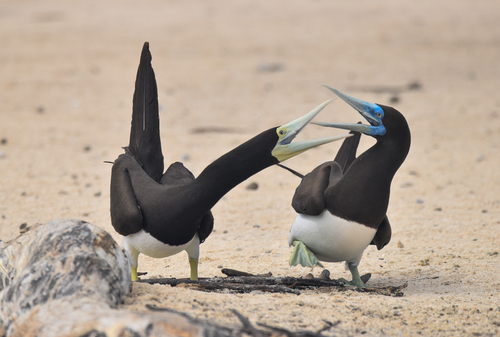
Dark chocolate brown head, neck, and upperparts; stark white lower breast and belly; yellow or greenish-yellow feet and legs; pale yellow bill.
Key Features
- Sharp contrast line between brown neck and white belly
- Long, pointed yellow bill
- Large, webbed yellow feet
- Slender, cigar-shaped body with long pointed tail
When You’ll See Them
Geographic range
Where Does the Brown Booby Live?
Native to the tropical and subtropical regions of the world's oceans, the Brown Booby has a massive pantropical distribution. They are found extensively throughout the Caribbean, the Gulf of Mexico, and the tropical Atlantic, as well as across the Pacific and Indian Oceans. In the United States, they are most common in the Florida Keys and Hawaii, though they are increasingly spotted as vagrants along the California and Gulf coasts as ocean temperatures shift.
Basemap © OpenStreetMap contributors
Behavior
The Brown Booby is a gregarious and highly social seabird, known for its incredible aerial agility and cooperative foraging. Unlike some of its relatives that hunt far out at sea, the Brown Booby often stays closer to shore, cruising at low altitudes over the waves before performing spectacular plunge-dives to catch prey. They are often seen in small groups, sometimes following fishing boats or even hitching a ride on the bows of ships.
On land, they are surprisingly bold and may show little fear of humans, particularly in areas where they are accustomed to boat traffic. They choose to roost on solid structures like piers, buoys, and rocky outcrops rather than floating on the water's surface. During the breeding season, they nest on the ground in colonies, where they perform elaborate courtship displays involving bill-pointing and sky-pointing to attract mates.
EverydayEarth exclusive
Camera Tips
Capturing a Brown Booby on a trail camera requires a coastal approach. If you have a property with a dock, pier, or a view of offshore pilings, focus your camera on these potential roosting sites. Brown Boobies prefer elevated, solid objects for resting, so mounting your camera 3-5 feet above a flat surface like a dock railing or a dedicated bird platform is ideal.
Because the sun reflects intensely off the water, use a camera with high dynamic range (HDR) settings to avoid blowing out the white plumage of the bird's belly. Point your camera away from the direct path of the sun (ideally North or South) to minimize glare. If your camera allows for shutter speed adjustments, use a fast setting to capture the crisp detail of their wings during takeoff or landing.
While you can't easily 'bait' a seabird with traditional feeders, you can attract them by providing a stable, clean roosting spot. A simple wooden platform or even a large, stationary buoy within camera range can act as a natural lure. Make sure your camera is triggered by motion and set to take a burst of 3-5 photos to capture their interesting grooming behaviors and social interactions.
Similar Species
Species that look similar or are commonly confused with Brown Booby.
Blue-footed Booby
Has bright blue feet and a mottled brown-and-white head, unlike the solid brown head of the Brown Booby.
Masked Booby
Much whiter overall with a dark 'mask' around the face and a bright yellow bill.
Red-footed Booby
Smaller with red feet; can have various color morphs but lacks the crisp 'waistline' contrast of the Brown Booby.
Frequently Asked Questions
Record Brown Booby at your habitat
Connect a camera to start building your own species record — AI identifies every visitor automatically.