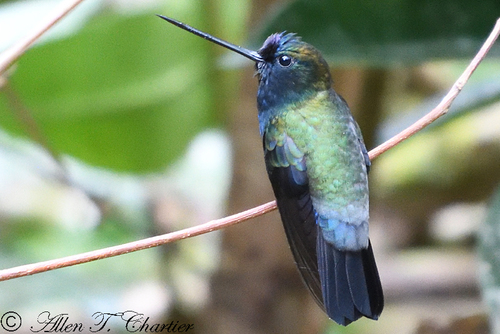
Blue-fronted Lancebill
Doryfera johannae
A hidden gem of the Andean foothills, the Blue-fronted Lancebill is a master of precision. With its extraordinary needle-like bill and a crown of shimmering violet-blue, this specialist hummingbird brings a touch of magic to the humid forests of South America.
Quick Identification
Size
9.5–11 cm (3.7–4.3 inches) in length; weighs approximately 3.4–4.8 grams.
Colors
Metallic dark green body with a distinct iridescent violet-blue forehead (males). Females are slightly duller with less pronounced forehead color and more greyish underparts.
Key Features
- Extremely long, needle-straight black bill
- Iridescent violet-blue crown patch on males
- Square-ended dark tail with greenish sheen
- Slightly decurved bill tip
When You’ll See Them
Geographic range
Where Does the Blue-fronted Lancebill Live?
Native to the northern half of South America, the Blue-fronted Lancebill thrives in the lush, humid corridors of the Andes and the Guiana Shield. Its primary range includes the moist foothills of Colombia, Ecuador, and Peru, extending eastward through the highlands of Venezuela and Guyana into northern Brazil. These birds are most commonly found in pristine tropical and subtropical forests where water is abundant.
Basemap © OpenStreetMap contributors
Behavior
The Blue-fronted Lancebill is a specialized hummingbird known for its 'trap-lining' foraging strategy. Unlike more aggressive hummingbird species that fiercely defend a single territory of flowers, the Lancebill follows a routine, long-distance circuit between scattered nectar sources. It is often found near fast-moving streams, waterfalls, and wet rock faces, where it expertly navigates the humid understory.
These birds are remarkably agile, often seen hovering in a near-vertical position to reach into deep, downward-hanging blossoms. While they are generally solitary, they are occasionally observed in loose associations with other hummingbirds at high-value nectar sites. In terms of human interaction, they are shy and tend to retreat into dense forest cover if disturbed.
EverydayEarth exclusive
Camera Tips
To capture the Blue-fronted Lancebill, location is everything. These birds are highly associated with water, so position your AI-powered camera near rocky stream banks or waterfalls where tubular flowers like Heliconias or Gesneriads are blooming. Set the camera at a height of about 1.5 meters (5 feet) and angle it toward the nectar-rich flowers rather than into the open forest.
Because hummingbirds have extremely fast wing beats, use the highest shutter speed or 'burst' setting your camera supports. If your device has an AI-trigger, calibrate it for 'small bird' detection. The iridescent blue forehead is most visible in direct light, so try to place your camera in a spot where the morning sun hits the foraging area to highlight their shimmering crown.
Since these birds are trap-liners, they are creatures of habit. If you record one at 8:00 AM, there is a high probability it will return to the same flower at roughly the same time the next day. Consistent placement is key. Avoid using standard hummingbird feeders, as Lancebills are specialists that prefer natural, downward-hanging blossoms over artificial plastic ports.
Similar Species
Species that look similar or are commonly confused with Blue-fronted Lancebill.
Frequently Asked Questions
Record Blue-fronted Lancebill at your habitat
Connect a camera to start building your own species record — AI identifies every visitor automatically.