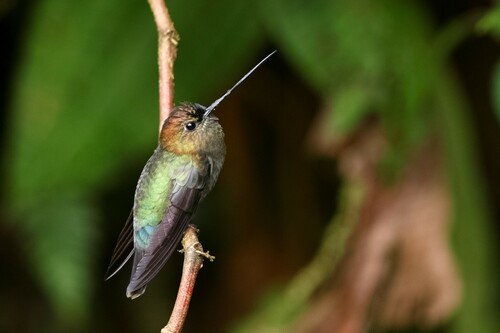
Green-fronted Lancebill
Doryfera ludovicae
A mist-dwelling specialist of the Andes, the Green-fronted Lancebill is famous for its sword-like bill and shimmering emerald forehead. This unique hummingbird thrives near rushing waterfalls, following secret mountain paths in search of nectar.
Quick Identification
Size
Length: 13-14 cm (5.1-5.5 inches); Weight: 5.7-7.8 grams (0.20-0.27 ounces)
Colors
Bronzy-green body with a brilliant, iridescent emerald-green patch on the forehead; long black bill and dark tail with greyish tips.
Key Features
- Extraordinarily long and straight black bill
- Glittering iridescent green forehead patch
- Bronzy-green plumage with dark underparts
- Typically found near mountain streams and waterfalls
When You’ll See Them
Geographic range
Where Does the Green-fronted Lancebill Live?
The Green-fronted Lancebill is native to the lush highlands of Central and South America. Its range follows the mountain corridors from the highlands of Costa Rica and Panama down through the Andes of Colombia, Venezuela, Ecuador, and Peru, reaching its southern limit in northern Bolivia. It is almost exclusively found in the humid subtropical and temperate zones of these mountain ranges.
Basemap © OpenStreetMap contributors
Behavior
The Green-fronted Lancebill is a highly specialized hummingbird known for its "trap-lining" foraging strategy. Instead of defending a single territory of flowers, it follows a set route every day, visiting specific blooms in a predictable sequence. This bird is most frequently seen darting through the understory of misty cloud forests, often staying close to the ground or over the surface of rushing mountain streams.
Unlike many hummingbirds that prefer open, sunny gardens, the Green-fronted Lancebill is a creature of the shadows and damp rock faces. It has a unique nesting habit, attaching its mossy, cup-shaped nest to the underside of rocky ledges, inside caves, or even under bridges, usually directly over water. This proximity to water provides safety from predators and a steady supply of small insects.
EverydayEarth exclusive
Camera Tips
To capture the elusive Green-fronted Lancebill on your backyard or trail camera, you must focus on their love for water and vertical terrain. If your property features a stream, a waterfall, or even a damp stone wall with overhanging vegetation, this is the prime spot for placement. Mount your camera 4 to 6 feet high, angled toward mossy rock faces or hanging moss where they might search for nesting materials or insects. Because they are shy and prefer shaded areas, ensure your camera's sensor is sensitive enough for lower light conditions.
While traditional hummingbird feeders may attract them, they are more likely to visit native, long-tubed flowers. If you use a feeder as a lure, place it in a quiet, shaded corner near a water feature rather than in the open sun. To get the best results, set your camera to a fast trigger speed and high-speed burst mode; their darting movements are exceptionally quick, and a slow camera will result in a green blur. If your camera supports it, a shutter speed of 1/2000s or higher is ideal for freezing their wing motion.
Pay close attention to the morning light. The "glittering" green forehead patch that gives this bird its name is highly iridescent and only shows up when the light hits it at the right angle. Positioning your camera to catch the soft, early morning sun (which is less likely to blow out the highlights) will produce the most dramatic and colorful images. Because they are trap-liners, they often visit the same spots at the same time every day—once you spot one on camera, keep your settings ready for its return the next day.
Similar Species
Species that look similar or are commonly confused with Green-fronted Lancebill.
Frequently Asked Questions
Record Green-fronted Lancebill at your habitat
Connect a camera to start building your own species record — AI identifies every visitor automatically.