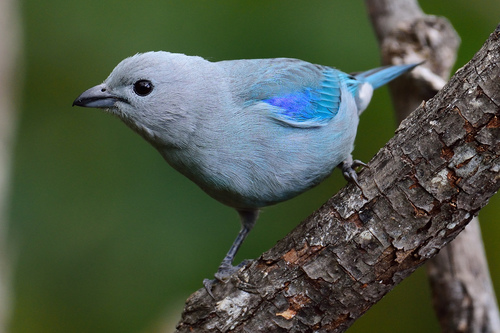
Blue-gray Tanager
Thraupis episcopus
Often called the 'Blue Jean' bird in the Caribbean, this social and vibrant tanager is a master of adaptation, bringing a flash of sky-blue to backyards and forests alike. It is one of the most friendly and visible tropical birds you can attract to your camera.
Quick Identification
Size
Length: 16–18 cm (6.3–7.1 in); Weight: 30–40 g (1.1–1.4 oz); Wingspan: 25–30 cm (10–12 in)
Colors
Powdery light blue body with darker, brighter azure on the wings and tail; sexes appear identical
Key Features
- Soft pale blue plumage throughout
- Distinctly darker blue-to-violet shoulder patches and wing edges
- Short, stout blackish bill
- Restless, hopping movement through branches
When You’ll See Them
Sightings on EverydayEarth
Jul 30, 2026
A group of tropical birds gathers at the fruit feeder in the morning light. A Clay-colored Thrush is the most prominent visitor, hopping onto the tray to eat from the sliced fruit. It is eventually joined by several Blue-gray Tanagers that land on the edges of the platform. In the background, a tiny Bananaquit visits the red hummingbird feeder before flitting down toward the main feeding area.
Jul 29, 2026
A male Thick-billed Euphonia is perched on the feeder tray, actively eating from sliced oranges. In the background, a Blue-gray Tanager perches quietly on a branch to the left of the feeder, observing the surroundings.
Jul 28, 2026
A variety of tropical birds, including Blue-gray Tanagers, a Bananaquit, and a Palm Tanager, are seen feeding on an assortment of fruit at the platform. A Clay-colored Thrush remains stationary on a nearby branch. The peaceful feeding session is interrupted when a Red-tailed Squirrel suddenly vaults onto the tray from below, causing the birds to quickly take flight as the squirrel begins to inspect the fruit.
Jul 25, 2026
A Palm Tanager lands on the feeder tray and begins to feed on the slices of banana and citrus. Shortly after, a Blue-gray Tanager lands on the far left edge of the platform before quickly moving out of the frame.
Jul 24, 2026
A lively scene at the fruit feeder featuring several tropical species. A male Crimson-backed Tanager feeds on oranges on the right, showing off its vibrant red rump. A Clay-colored Thrush occupies the center of the tray, while a Blue-gray Tanager arrives on the left railing late in the observation. The birds are actively feeding on the halved oranges and bananas provided.
Jul 23, 2026
Multiple bird species are active at the fruit feeder during a rain shower. A male Thick-billed Euphonia and a Social Flycatcher hop between fruit slices, while a Blue-gray Tanager briefly visits the right side. A Clay-colored Thrush arrives at the end of the clip, perching on the right edge of the tray to begin feeding.
Geographic range
Where Does the Blue-gray Tanager Live?
This species is a widespread resident of the Neotropics, stretching from southern Mexico through Central America and across the northern half of South America as far south as Bolivia and northern Brazil. While they are native to the lush landscapes of the Amazon Basin, they have also successfully established introduced populations in Lima, Peru, and even parts of southern Florida, where the tropical climate mirrors their home range.
Basemap © OpenStreetMap contributors
Recorded on EverydayEarth
Behavior
While they aren't known for complex melodies, they are vocal birds that communicate with a series of high-pitched, squeaky chirps and twittering notes. They are bold around feeders and bird baths, often holding their own against larger species. In the wild, they are frequent members of mixed-species foraging flocks, acting as sentinels that help alert other birds to potential predators.
EverydayEarth exclusive
Camera Tips
To capture the best footage of Blue-gray Tanagers, place your camera near a platform feeder or a fruit-producing tree like a papaya, mango, or fig. They are particularly fond of overripe bananas; securing a half-peeled banana to a branch and focusing your camera on it is almost a guarantee for a close-up. Position the camera at a height of 5 to 10 feet, as these birds prefer staying slightly above the ground but below the high canopy.
Bird baths are another excellent location for AI-powered cameras. Blue-gray Tanagers are frequent bathers and their pale blue feathers create stunning reflections in the water. For the sharpest images, set your camera to a fast shutter speed to freeze their rapid wing movements during a bath. Ensure the camera is angled to catch the morning sun, which highlights the subtle violet and azure hues in their wing coverts.
Because they are highly active in the early morning, ensure your camera's sensitivity is high enough to trigger in lower light conditions just after dawn. If you are using a trail camera, a 3-shot burst mode is ideal to capture their characteristic 'hop-and-stop' foraging behavior. In suburban areas, they often follow a routine, so once you spot them on camera, they are likely to return at the same time every day.
Similar Species
Species that look similar or are commonly confused with Blue-gray Tanager.
Sayaca Tanager
Very similar but has a slightly more greenish tint to the blue and lacks the bright azure wing patches of the Blue-gray.
Palm Tanager
Lacks the blue entirely, featuring a duller olive-gray or brownish-gray plumage, though it shares the same shape and social habits.
Azure-shouldered Tanager
Darker overall with much more intense blue on the wings and a heavier bill.
Frequently Asked Questions
Record Blue-gray Tanager at your habitat
Connect a camera to start building your own species record — AI identifies every visitor automatically.