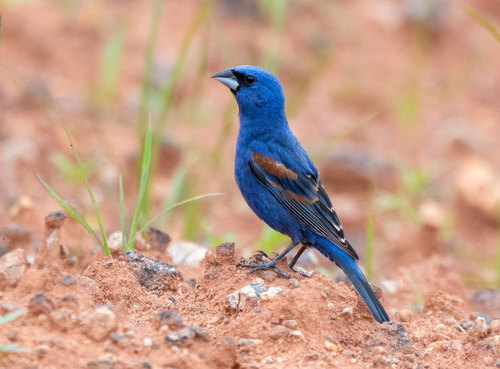
Blue Grosbeak
Passerina caerulea
With its stunning deep-blue plumage and chunky silver bill, the Blue Grosbeak is a shy but spectacular visitor to North American thickets and fields. Often identified by its unique tail-flicking habit, this migratory songbird brings a touch of tropical color to the backyard edge.
Quick Identification
Size
Length: 15–19 cm (5.9–7.5 in); Wingspan: 26–29 cm (10–11 in); Weight: 26–31 g (0.92–1.1 oz)
Colors
Adult males are deep cobalt blue with two distinct chestnut-brown wing bars. Females are warm cinnamon-brown overall, featuring lighter underparts and the same characteristic brown wing bars, occasionally with blue feathers on the rump.
Key Features
- Large, heavy silver-grey conical bill
- Two prominent cinnamon-brown wing bars on both sexes
- Deep cobalt blue plumage in breeding males
- Frequent habit of flicking its tail sideways and down
When You’ll See Them
Geographic range
Where Does the Blue Grosbeak Live?
The Blue Grosbeak is a native of North and Central America, primarily breeding across the southern and central United States and northern Mexico. These migratory birds spend their winters in the tropical regions of Mexico and Central America, reaching as far south as Panama. In recent decades, their breeding range has been steadily expanding northward into the Mid-Atlantic and Midwest states as they take advantage of warming summers and changing land use.
Basemap © OpenStreetMap contributors
Behavior
Blue Grosbeaks are somewhat secretive birds that prefer the cover of dense thickets and overgrown fields. Unlike some of their more bold cardinal relatives, they tend to stay low in the vegetation, often foraging on the ground for seeds and insects. They are most easily spotted when the male perches on a high wire or the tip of a shrub to sing his rich, warbling song, which sounds like a more refined version of a Purple Finch's melody.
One of the most diagnostic behaviors of the Blue Grosbeak is its restless tail. While perched, they frequently twitch their tails downward and to the side, a nervous habit that helps birdwatchers identify them from a distance. During the nesting season, they are territorial and solitary, though they may form small, loose groups during migration as they head toward their tropical wintering grounds.
EverydayEarth exclusive
Camera Tips
To capture the Blue Grosbeak on your backyard camera, focus your efforts on the 'wilder' edges of your property. These birds avoid open lawns, so place your camera near dense shrubbery, overgrown fence lines, or where tall grasses meet woodland. Because they are low-level foragers, a camera mounted on a stake just 2 to 3 feet above the ground will yield the best results, providing an intimate eye-level view of their foraging behavior.
While they aren't the most frequent visitors to hanging feeders, you can entice them by creating a ground-level feeding station. Scatter sunflower seeds, millet, or cracked corn near the base of a bush. Even better, use mealworms to attract them during the nesting season when they are hunting for high-protein food to feed their chicks. Providing a water source with a gentle 'dripper' or moving water is one of the most effective lures, as the sound of splashing water is irresistible to this species for both drinking and bathing.
For the best lighting and activity levels, ensure your camera is active during the first three hours of daylight. Males are most vocal and visible during the late spring and early summer when they are defending territories. Set your camera's trigger speed to its fastest setting and use 'burst mode' if available; Blue Grosbeaks are twitchy birds, and the tail-flicking behavior that makes them unique can often be missed by slower sensors. If you live in their northern range, your best window for success is June through August.
Similar Species
Species that look similar or are commonly confused with Blue Grosbeak.
Indigo Bunting
Much smaller with a thinner bill and lacks the cinnamon-brown wing bars.
Mountain Bluebird
Has a thinner, insect-eating bill and lacks the chunky grosbeak shape and brown wing bars.
Northern Cardinal
Similar size and beak shape, but males are red with a prominent crest, whereas Blue Grosbeaks are blue and lack a crest.
Frequently Asked Questions
Record Blue Grosbeak at your habitat
Connect a camera to start building your own species record — AI identifies every visitor automatically.