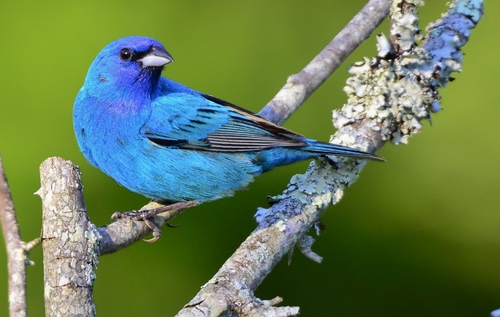
Indigo Bunting
Passerina cyanea
A shimmering 'blue jewel' of the summer fields, the Indigo Bunting is a master navigator that travels thousands of miles by the light of the stars. Learn how to spot this vibrant songbird in your own backyard.
Quick Identification
Size
Length: 4.7–5.1 in (12–13 cm); Wingspan: 7.1–9.1 in (18–23 cm); Weight: 0.4–0.6 oz (11–18 g)
Colors
Adult males are a brilliant, iridescent cerulean blue during the breeding season; females and juveniles are warm brown with faint wing bars and a touch of blue on the tail.
Key Features
- Adult males are entirely vibrant blue with a silver-grey beak
- Females are brownish with light breast streaking and a whitish throat
- Distinctive 'double-note' whistling song
- Migrates primarily at night using celestial navigation
When You’ll See Them
Geographic range
Where Does the Indigo Bunting Live?
The Indigo Bunting is a native of the North American continent, with a vast breeding range that stretches from southern Canada down through the eastern and central United States to the Gulf Coast. As a neotropical migrant, it leaves these northern territories in the fall to winter across Mexico, Central America, and the Caribbean, sometimes reaching the northernmost tips of South America. They are most densely populated in the eastern half of the U.S., particularly where forest meets open farmland.
Basemap © OpenStreetMap contributors
Behavior
Indigo Buntings are famous for their tireless singing. During the peak of summer, while other birds fall silent in the heat, males can be found perched on the highest available branches or power lines, repeating their sharp, whistling phrases. These birds are highly energetic and spent much of their time flitting through low-density brush or tall weeds in search of food. Interestingly, the male's blue color is not caused by pigment but by 'structural color'—the way the feathers reflect light. In the shade or poor lighting, a male can actually appear black or dark grey.
During the breeding season, they are territorial and mostly solitary, but they become much more social during migration and on their wintering grounds in the tropics. They are renowned in the scientific community for their incredible navigational abilities; studies have proven that they learn to navigate by the stars, specifically using the rotation of the night sky around the North Star to find their way during their long journeys between continents.
EverydayEarth exclusive
Camera Tips
To capture the stunning iridescent blue of a male Indigo Bunting, lighting is your most important tool. Because their color is structural, the bird will look most vibrant if the camera is positioned with the sun at its back, shining directly onto the bird's chest. Avoid placing cameras where the bird will be backlit, as this will turn the brilliant blue into a dull, dark silhouette. Look for 'edge' habitats in your yard—the place where your lawn meets a line of bushes or woods—and mount your camera at about 4 to 5 feet high on a fence post or a slender tree.
If you want to lure them into your camera's field of view, water is often more effective than food. Indigo Buntings are frequent bathers. A shallow birdbath with a 'wiggler' or a small fountain to create moving water is irresistible to them during the hot summer months. Position your camera about 3 feet from the water source for the best detail. If you prefer using a feeder, tray feeders or platform feeders stocked with white proso millet, nyjer (thistle), or hulled sunflower seeds are your best bet, as they are more comfortable on flat surfaces than hanging perches.
For camera settings, use a high shutter speed or a high-frame-rate video mode. Buntings are fast and 'twitchy,' frequently flicking their tails and wings. A trigger speed of 0.3 seconds or less is ideal to ensure you don't just catch a tail feather as they fly off. If you are using an AI-powered camera, ensure the 'small bird' sensitivity is high, as they are lightweight and may not always trigger sensors designed for larger mammals. During the peak of May migration, keep your camera running throughout the day, as new arrivals may drop in at any hour to refuel.
Similar Species
Species that look similar or are commonly confused with Indigo Bunting.
Blue Grosbeak
Larger with a much heavier beak and distinctive rusty-brown wing bars.
Lazuli Bunting
Found in the West; males have an orange breast and white belly, while Indigos are all blue.
Eastern Bluebird
Larger with a bright orange chest and a more upright posture; lacks the all-over blue of the male bunting.
Frequently Asked Questions
Record Indigo Bunting at your habitat
Connect a camera to start building your own species record — AI identifies every visitor automatically.