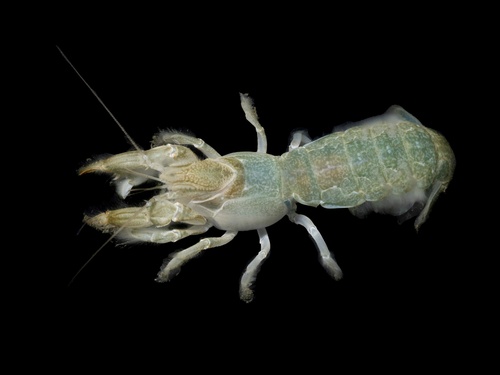
Blue Mud Shrimp
Upogebia pugettensis
The Blue Mud Shrimp is a master architect of the West Coast's muddy shores. These fascinating 'mud lobsters' build complex underground cities that support an entire community of marine life.
Quick Identification
Size
Typically 10-15 cm (4-6 inches) in length
Colors
Dull blue-grey, brownish-grey, or olive-green; underside is usually lighter or off-white; pincers may have darker tips
Key Features
- Large, nearly equal-sized pincers (chelae)
- Dense, hair-like setae on legs and claws
- Deep, permanent Y-shaped burrows in mudflats
- Stout, lobster-like body with a flexible abdomen
When You’ll See Them
Geographic range
Where Does the Blue Mud Shrimp Live?
The Blue Mud Shrimp is a native icon of the North American Pacific Coast. Its range extends from the chilly waters of the Kenai Peninsula in Alaska southward through the nutrient-rich estuaries of British Columbia and the Pacific Northwest, reaching as far south as Morro Bay in Central California. These shrimp are highly localized to stable mudflat environments where the sediment is firm enough to support their complex, long-term burrow structures.
Basemap © OpenStreetMap contributors
Behavior
The Blue Mud Shrimp is a reclusive ecosystem engineer that spends almost its entire life within elaborate, permanent burrow systems. Unlike many other crustaceans, they are diligent housekeepers, constantly pumping water through their tunnels using fan-like pleopods (swimmerets) on their abdomen. This pumping action isn't just for breathing; it’s a sophisticated feeding strategy that pulls nutrient-rich water and plankton into their home.
Socially, these shrimp are often found in high-density colonies, though each maintains its own private tunnel. They are known for hosting a variety of 'roommates' or commensal species, including pea crabs, scale worms, and small gobies that live within the safety of the shrimp's burrow. While they are docile toward humans, they are currently facing a massive ecological threat from an invasive parasitic isopod that attaches to their gills and prevents them from reproducing.
EverydayEarth exclusive
Camera Tips
Capturing the Blue Mud Shrimp requires a different approach than typical backyard wildlife because they live underground and underwater. The most effective method is using a waterproof action camera, like a GoPro, mounted on a small, low-profile weighted tripod. Locate a Y-shaped burrow entrance during low tide—these are often marked by small mounds of mud and a clear opening about the diameter of a thumb. Place your camera just a few inches from the hole, angled slightly downward to catch the shrimp when it surfaces to clear debris or circulate water.
Timing is everything. Set your camera to record or use a time-lapse mode during the transitional period when the tide begins to cover the mudflat. As the water returns, the shrimp becomes highly active, pumping water and occasionally appearing at the mouth of the burrow. Because the water in estuaries is often turbid (cloudy), filming on days with calm weather and clear water will significantly improve your visibility.
If you are using a trail camera near the shoreline, look for areas where the tide recedes enough to expose the mud for several hours. While you won't catch them running across the surface, a camera with a good macro focus or close-up lens can capture the fascinating 'pulsing' of water coming out of the burrow. Avoid using bright white flashes at night as this can startle the shrimp and its commensal guests; instead, rely on ambient light or very low-intensity infrared if your camera supports it.
Similar Species
Species that look similar or are commonly confused with Blue Mud Shrimp.
Frequently Asked Questions
Record Blue Mud Shrimp at your habitat
Connect a camera to start building your own species record — AI identifies every visitor automatically.