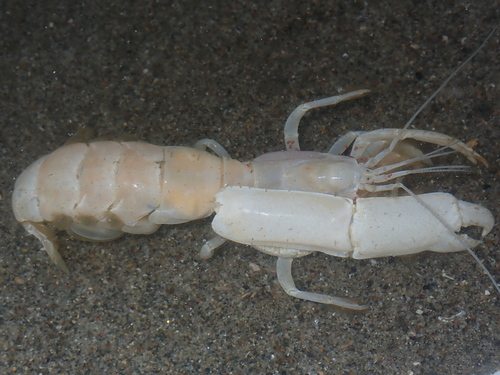
Giant Ghost Shrimp
Neotrypaea gigas
The translucent 'architect of the tideflats,' Giant Ghost Shrimp are secretive engineers that build vast subterranean cities beneath our feet.
Quick Identification
Size
6-8 inches (15-20 cm) in length; weight 30-60 grams
Colors
Translucent white to pale cream; internal organs often visible; males feature one oversized, bright white primary claw
Key Features
- Ghostly translucent exoskeleton
- Massive, asymmetrical primary claw in males
- Long, soft abdomen
- Fan-like tail and feathery swimmerets
When You’ll See Them
Geographic range
Where Does the Giant Ghost Shrimp Live?
The Giant Ghost Shrimp is native to the Eastern Pacific coastline of North America. Its range extends from the cool, temperate waters of British Columbia, Canada, southward through the United States—specifically Washington, Oregon, and California—to the warmer shores of Baja California, Mexico. They are most abundant in nutrient-rich estuaries where stable tidal flats provide the perfect consistency of mud and sand for their deep burrowing activities.
Basemap © OpenStreetMap contributors
Behavior
The Giant Ghost Shrimp is a master subterranean architect, spending nearly its entire life within complex, Y-shaped burrow systems that can extend over three feet deep into the sediment. These shrimp are considered ecosystem engineers; their constant digging and ventilating of tunnels aerate the sand, recycling nutrients that support a vast array of other marine life. They are rarely seen on the surface, making them one of the more mysterious residents of the intertidal zone.
Within their tunnels, ghost shrimp exhibit a rhythmic behavior, using their pleopods (swimmerets) to create a constant current of water. This serves the dual purpose of bringing in oxygen and carrying away waste. While they are generally solitary in their specific tunnel branches, they live in high-density colonies where the beach surface becomes a honeycomb of burrow entrances. They are non-aggressive but highly sensitive to vibrations on the sand above.
EverydayEarth exclusive
Camera Tips
Because Giant Ghost Shrimp live underground, capturing them requires focusing on their burrow entrances during low tide. For coastal residents, placing a waterproof action camera on a weighted low-profile tripod is the best approach. Aim the lens at a 'volcano-style' sand mound with a clear opening. The best time to film is during the two-hour window around the lowest point of the tide when the shrimp are most likely to perform 'housekeeping'—pushing excess sediment out of their tunnels.
To get clear footage, use a camera with a strong macro capability or a close-focusing lens, as the shrimp will rarely emerge more than an inch or two from the hole. Using an external light source, like a waterproof LED, can help illuminate the translucent body against the dark sand, revealing the fascinating internal anatomy that gives the 'ghost' shrimp its name. Avoid using heavy tripods that might sink into the mud or create vibrations that keep the shrimp deep underground.
Set your camera to a high-frame-rate video setting or a rapid time-lapse (one photo every 5 seconds). Movement at the burrow mouth is often subtle—a twitch of an antenna or a puff of silt. If you are lucky, you will catch a male displaying his massive primary claw near the entrance to deter rivals or attract mates. In summer months, look for the 'pulsing' water at the entrance, which indicates the shrimp is active and fanning its swimmerets just below the surface.
Similar Species
Species that look similar or are commonly confused with Giant Ghost Shrimp.
Frequently Asked Questions
Record Giant Ghost Shrimp at your habitat
Connect a camera to start building your own species record — AI identifies every visitor automatically.