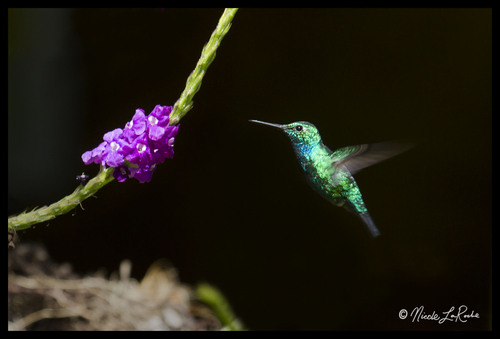
Blue-tailed Emerald
Chlorostilbon mellisugus
A glittering gem of the South American lowlands, the Blue-tailed Emerald captivates with its brilliant green hue and spirited personality. Frequently seen darting through tropical gardens, this resilient hummingbird is a favorite for backyard observers and wildlife photographers alike.
Quick Identification
Size
7.5–9 cm (3–3.5 in) long; weight approximately 2.5–3.5 grams
Colors
Males are shimmering emerald green with a deeply forked dark blue-black tail; females are bronze-green above with greyish underparts and a distinctive white stripe behind the eye.
Key Features
- Metallic emerald green plumage on males
- Deeply forked, steel-blue to black tail
- Straight black bill, 13–18 mm long
- Female has a dark ear-patch bordered by a white post-ocular streak
When You’ll See Them
Geographic range
Where Does the Blue-tailed Emerald Live?
Native to the sun-soaked regions of tropical and subtropical South America, the Blue-tailed Emerald is primarily found east of the Andes. Its vast range extends from the northern coasts of Colombia, Venezuela, and the island of Trinidad, stretching through the Guianas and deep into the central Amazonian regions of Brazil. It also reaches the northern frontiers of Bolivia, making it one of the most widely distributed emerald hummingbirds on the continent.
Basemap © OpenStreetMap contributors
Behavior
The Blue-tailed Emerald is a high-energy, territorial hummingbird known for its aggressive defense of nectar sources. Despite its diminutive size, it will fearlessly chase away much larger birds and even rival hummingbirds from its favorite flowering shrubs. They are "trap-line" foragers, meaning they follow a specific route between flowers, but they also establish a home base where they defend high-quality nectar patches.
In garden settings, they are remarkably bold and can become accustomed to human presence, often hovering just a few feet away from observers. They are mostly solitary outside of the breeding season, spending their days darting between blooms with a distinctive, high-pitched buzzing flight sound. Unlike some forest-dwelling hummingbirds, they prefer more open, sun-drenched environments where their iridescent feathers can catch the light.
EverydayEarth exclusive
Camera Tips
To capture the stunning iridescence of the Blue-tailed Emerald, camera placement is everything. Position your AI-powered camera within 2 to 4 feet of a nectar feeder or a cluster of red or tubular flowers like Hibiscus or Porterweed. Ensure the lens is angled so the sun is behind the camera; this "front-lighting" is essential to illuminate the metallic green structural colors of the male's feathers, which otherwise look dull or black in the shade.
Because these birds move with incredible speed, use a high shutter speed setting if your camera allows manual overrides, or select a 'sports' or 'action' mode to minimize motion blur. A side-profile angle is best for identifying the species, as it clearly captures the deeply forked blue tail and the straight black bill. If using a trail camera, ensure the PIR sensor is set to its highest sensitivity, as these tiny birds have a small heat signature and move quickly through the detection zone.
Consider setting up your station near a "perching twig"—a small, bare branch about 5–10 feet away from a feeder. Blue-tailed Emeralds often pause there to survey their territory between feedings. This provides the perfect opportunity for still shots while the bird is motionless. In backyard settings, avoid placing cameras too close to heavy human foot traffic, but keep them near flowering edges where the birds naturally forage.
Similar Species
Species that look similar or are commonly confused with Blue-tailed Emerald.
Frequently Asked Questions
Record Blue-tailed Emerald at your habitat
Connect a camera to start building your own species record — AI identifies every visitor automatically.