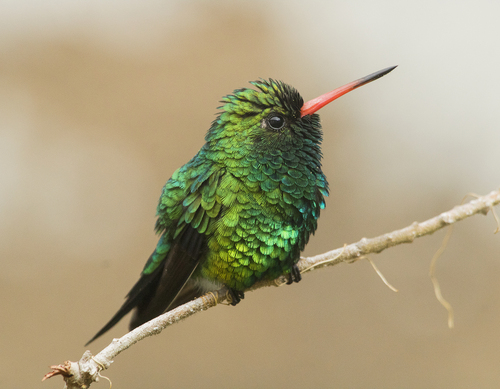
Glittering-bellied Emerald
Chlorostilbon lucidus
A shimmering jewel of the southern hemisphere, the Glittering-bellied Emerald brings a flash of metallic green and a bold spirit to backyards across South America.
Quick Identification
Size
Length: 7.5–10.5 cm (3–4 in); Wingspan: ~11 cm (4.3 in); Weight: 3–4 g (0.1–0.14 oz)
Colors
Males are brilliant golden-green with a blue-green throat and a red bill tipped in black. Females are metallic green above with pale greyish-white underparts.
Key Features
- Brilliant golden-green plumage with a metallic sheen
- Bright red bill with a distinct black tip
- Deeply forked, dark blue-black tail
- Small white spot behind the eye, especially prominent in females
When You’ll See Them
Geographic range
Where Does the Glittering-bellied Emerald Live?
The Glittering-bellied Emerald is a quintessential South American species, making its home across the central and southern reaches of the continent. Its core range spans the vast landscapes of Brazil, stretching down through the grasslands of Uruguay and the humid forests of Paraguay. It is a common sight throughout northern and central Argentina and extends westward into the lowlands of eastern Bolivia. While it is primarily a resident species throughout its range, some populations may move locally following the seasonal blooming of its favorite flowers.
Basemap © OpenStreetMap contributors
Behavior
The Glittering-bellied Emerald is a highly energetic and territorial hummingbird known for its bold personality. Despite its small size, it frequently defends its favorite feeding patches from other hummingbirds and even larger bird species. You will often see them hovering with incredible precision as they sip nectar, their wings beating so fast they become a blur. They are remarkably well-adapted to human environments and are frequent visitors to backyard gardens and urban parks.
Socially, these birds are solitary except during the breeding season. Males perform dazzling aerial displays to attract mates, utilizing the sun to catch the iridescence of their feathers. They do not form long-term pair bonds; the female takes on the entire responsibility of building the tiny, cup-shaped nest out of plant fibers and spider webs, as well as raising the chicks. In residential areas, they can become quite accustomed to human presence, often feeding just a few feet away from observers.
EverydayEarth exclusive
Camera Tips
To capture the stunning iridescence of the Glittering-bellied Emerald, camera placement is everything. Position your AI-powered camera approximately 3 to 5 feet away from a nectar-rich food source, such as a red tubular-flower patch or a hummingbird feeder. Because these birds are incredibly fast, ensure your camera is set to its highest possible shutter speed or 'Sports/Action' mode to freeze the wing motion. If your camera supports it, enable a 'Pre-roll' or 'High-speed' trigger setting, as these birds can dart in and out of the frame in less than a second.
Lighting is the 'secret sauce' for photographing this species. To make the 'glittering' belly and red bill pop, place your camera with the sun behind it, shining directly onto the bird's chest. This front-lighting setup ensures the metallic feathers reflect light back into the lens. If you are using a trail camera, mount it at chest height (about 4-5 feet) and angle it slightly upward if the bird is feeding on hanging flowers. Using a camera with a macro or close-focus capability is highly recommended given their tiny size.
For the best results, look for a 'perching branch' near your feeder. Hummingbirds often sit on a nearby twig to survey their territory or rest between feeds. If you can identify this favorite perch, aim your camera there; you will get much sharper, more intimate shots than you would of the bird in flight. Since they are active from dawn to dusk, ensure your camera's sensitivity is adjusted for the softer light of early morning, which is often when they are most active and competitive at feeders.
Similar Species
Species that look similar or are commonly confused with Glittering-bellied Emerald.
Frequently Asked Questions
Record Glittering-bellied Emerald at your habitat
Connect a camera to start building your own species record — AI identifies every visitor automatically.