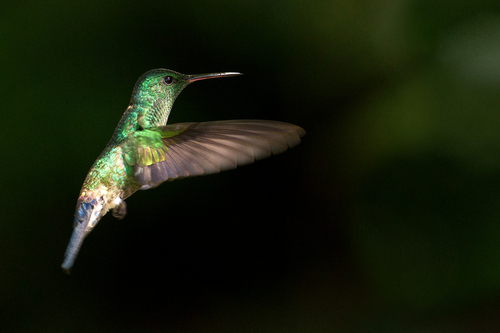
Blue-vented Hummingbird
Saucerottia hoffmanni
A shimmering emerald of the Central American tropics, the Blue-vented Hummingbird is a bold and energetic visitor to gardens and forest edges alike. Known for its feisty personality and a hidden splash of violet-blue, it is a master of aerial acrobatics.
Quick Identification
Size
9 to 10 cm (3.5 to 3.9 in) long; weight approximately 4 to 4.5 g (0.14 to 0.16 oz)
Colors
Metallic bronze-green upperparts and brilliant emerald green underparts; distinctive deep violet-blue or blue-black undertail coverts; tail is dark blue-black or bronze-green.
Key Features
- Iridescent emerald green throat and breast
- Deep blue to violet-black undertail coverts (the 'vent')
- Straight black bill with a pale reddish base on the lower mandible
- Dark, notched tail with a metallic sheen
When You’ll See Them
Geographic range
Where Does the Blue-vented Hummingbird Live?
The Blue-vented Hummingbird is native to the tropical landscapes of Central America, specifically concentrated along the Pacific and central highlands. Its core range spans the length of Nicaragua and Costa Rica, where it is a familiar sight in both humid and seasonally dry environments. While it avoids the deepest interior of primary rainforests, it has successfully expanded its presence in agricultural regions and suburban neighborhoods throughout these two countries.
Basemap © OpenStreetMap contributors
Behavior
In a backyard setting, these birds follow a 'trap-lining' foraging strategy, meaning they visit a specific route of flowers at regular intervals throughout the day. When not feeding, they prefer to sit on high, exposed thin branches or telephone wires, which give them a panoramic view of their territory. This allows them to quickly spot intruders or passing insects. Their activity is almost entirely diurnal, beginning shortly after dawn and continuing until the light fades in the evening.
While they are primarily solitary, they are a common sight in coffee plantations and suburban areas where flowering hedges are present. During the breeding season, males may perform short display flights, but they do not form long-term pair bonds, with females taking on the entirety of the nest-building and chick-rearing duties in a tiny, cup-shaped nest made of plant fibers and spider webs.
EverydayEarth exclusive
Camera Tips
To capture the stunning iridescence of the Blue-vented Hummingbird, place your camera within 15 to 20 inches of a hummingbird feeder or a cluster of vibrant red or orange flowers. This species is particularly attracted to Porterweed (Stachytarpheta) and Firebush (Hamelia patens). Because their wings beat up to 80 times per second, you will need a camera with a very fast trigger speed or a high-speed video mode (at least 60fps) to avoid a total blur. If using a trail camera, ensure it has a 'near-focus' lens or a macro setting, as standard trail cams often have a minimum focus distance of 3 to 5 feet, which is too far for a bird this small.
Lighting is your most important ally with this species. The 'blue vent' and emerald throat only shimmer when the light hits them at the correct angle. Position your camera facing north or south so that the morning or afternoon sun illuminates the bird from the side or front. Avoid backlighting, which will turn the bird into a dark silhouette and hide its signature colors. If your camera allows for exposure control, slightly underexposing the image can help preserve the detail in the bright metallic feathers that often 'blow out' in direct tropical sunlight.
A secret tip for capturing still shots is to locate the bird's 'guard perch.' These hummingbirds are creatures of habit and will often return to the exact same bare twig or wire between feeding sessions to survey their territory. If you see a hummingbird returning to the same spot repeatedly, move your camera to focus on that branch. You will get much sharper images of the bird while it is perched and stationary than you will while it is hovering at a flower.
Keep your camera gear clean; in the humid environments where these birds live, lenses can fog up quickly or attract ants if you are using sugar-water feeders. Using a small rain shield or housing can protect the sensors. If your camera features AI-powered bird detection, ensure it is set to high sensitivity, as the small size and rapid movement of the Blue-vented Hummingbird can sometimes be missed by slower motion sensors.
Similar Species
Species that look similar or are commonly confused with Blue-vented Hummingbird.
Steely-vented Hummingbird
Very closely related but found from Nicaragua northward into Mexico; it has paler, more bronzish undertail coverts.
Rufous-tailed Hummingbird
Shares the same habitat but is easily distinguished by its bright reddish-brown tail and a pinkish base to the bill.
Beryl-spangled Tanager
Though a different family, its shimmering green can confuse beginners; however, it is much larger with a thick songbird beak.
Frequently Asked Questions
Record Blue-vented Hummingbird at your habitat
Connect a camera to start building your own species record — AI identifies every visitor automatically.