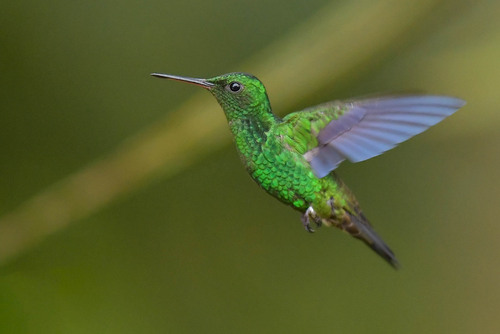
Steely-vented Hummingbird
Saucerottia saucerottei
A feisty emerald of the Andes and beyond, the Steely-vented Hummingbird brings a flash of brilliant green and a bold personality to every garden it visits.
Quick Identification
Size
8.9–11 cm (3.5–4.3 in) long; wingspan of approximately 12 cm (4.7 in); weight 3.8–4.5 g (0.13–0.16 oz)
Colors
Brilliant emerald-green head and body; deep blue-black or steel-blue tail; dull grey or bronzy-blue undertail coverts (the 'vent')
Key Features
- Glittering iridescent green plumage on the throat and breast
- Deep blue-black tail with a slight notch
- Distinctive greyish-blue undertail coverts
- Straight, medium-length black bill
When You’ll See Them
Geographic range
Where Does the Steely-vented Hummingbird Live?
The Steely-vented Hummingbird is a quintessential South American gem, primarily inhabiting the northern reaches of the continent. Its native range is concentrated within the diverse landscapes of Colombia and Venezuela, where it is found from the coastal lowlands up into the Andean foothills. As a resident species, it does not migrate, making it a reliable year-round sight for birdwatchers in these regions.
Basemap © OpenStreetMap contributors
Behavior
The Steely-vented Hummingbird is a high-energy, pugnacious species known for its bold personality. It is highly territorial and will aggressively defend a rich nectar source, such as a flowering tree or a backyard feeder, against other hummingbirds and even larger bird species. These birds are 'trap-liners,' meaning they often follow a set route through the landscape, visiting the same flowers at regular intervals throughout the day.
Despite their aggressive nature toward competitors, they are relatively tolerant of human presence and can become quite accustomed to backyard activity. They spend much of their time perched on high, exposed twigs between feeding bouts, where they scan for intruders or passing insects. Their social structure is largely solitary, coming together only briefly for mating, after which the female handles all nesting and chick-rearing duties.
EverydayEarth exclusive
Camera Tips
To successfully capture the Steely-vented Hummingbird on your backyard camera, focus on 'sentinel' perches. These birds love to sit on thin, bare branches near their favorite flowers to keep watch. Position your camera about 3 to 4 feet away from a cluster of nectar-rich plants like Salvia or Firebush, and try to angle it so the morning sun hits the bird's chest, which will ignite that stunning green iridescence on film.
Because hummingbirds have an incredibly fast wingbeat, motion-blur is common. If your AI camera allows for shutter speed adjustments, try to set it to at least 1/2000th of a second for crisp action shots. If you are using a feeder to attract them, place the camera at the same height as the feeding ports. This species is often the 'boss' of the feeder, so you are likely to capture dramatic footage of them chasing away rivals.
Seasonal considerations are minimal since they are residents, but they are most active during the rainy season when floral blooms are at their peak. Ensure your camera is set to a high-sensitivity trigger mode, as these birds move in and out of the frame in the blink of an eye. Using a camera with a pre-record or 'buffer' feature is a game-changer, as it captures the seconds of flight before the motion sensor is even triggered.
Similar Species
Species that look similar or are commonly confused with Steely-vented Hummingbird.
Frequently Asked Questions
Record Steely-vented Hummingbird at your habitat
Connect a camera to start building your own species record — AI identifies every visitor automatically.