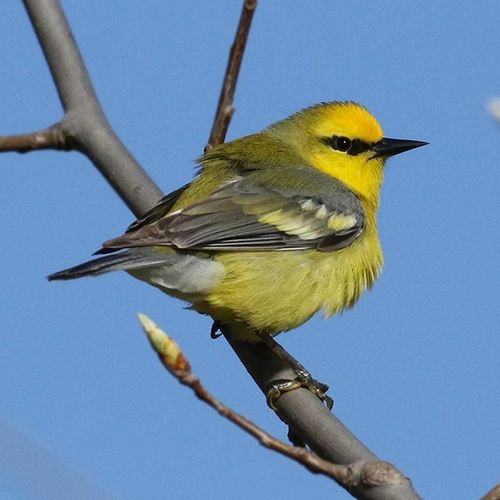
Blue-winged Warbler
Vermivora cyanoptera
A dazzling spark of gold in the brush, the Blue-winged Warbler is a master of the forest edge. With its sharp black eye-line and namesake blue-gray wings, this migratory gem is a prize for any backyard observer.
Quick Identification
Size
Length: 11.5 cm (4.5 in); Wingspan: 17.5 cm (6.9 in); Weight: 8.5 g (0.3 oz)
Colors
Vibrant yellow head and underparts, blue-gray wings with two white wing bars, and a distinctive thin black eye-line.
Key Features
- Bright yellow body and crown
- Thin black line running through the eye
- Blue-gray wings with two white bars
- White outer tail feathers visible in flight
When You’ll See Them
Geographic range
Where Does the Blue-winged Warbler Live?
Native to the Western Hemisphere, the Blue-winged Warbler spends its summers breeding across the eastern United States and southern Ontario, Canada. As a migratory species, it travels south each autumn to find warmer climates, wintering primarily in southern Mexico and throughout Central America as far south as Panama. This bird is currently expanding its breeding range northward, often moving into territories formerly held by the closely related Golden-winged Warbler.
Basemap © OpenStreetMap contributors
Behavior
The Blue-winged Warbler is an active, acrobatic forager often found in scrubby, early-successional habitats. It has a unique way of searching for food, frequently hanging upside down from the ends of branches or probing into curled dead leaves to find hidden insects, much like a chickadee. During the breeding season, males are highly territorial and can be heard singing their buzzy, two-note song—often described as a 'beeee-buzzz'—from high perches within their brushy domains.
While they are primarily solitary during the breeding season, they may join mixed-species foraging flocks during migration. Interestingly, this species is known for its complex relationship with the Golden-winged Warbler; the two species frequently hybridize where their ranges overlap, producing offspring known as 'Brewster’s' or 'Lawrence’s' Warblers. In backyard settings, they are shy and rarely visit traditional seed feeders, but they are highly attracted to moving water.
EverydayEarth exclusive
Camera Tips
To capture the Blue-winged Warbler on your AI-powered camera, placement is everything. Unlike larger birds that frequent high canopies, these warblers prefer the 'shrub layer'—usually between 2 and 6 feet off the ground. Position your camera near thickets, elderberry bushes, or raspberry brambles. If you have a backyard bird bath, adding a 'dripper' or a small solar fountain is the single most effective way to lure them into frame; these birds are suckers for the sound of moving water.
Since Blue-winged Warblers are fast-moving and relatively small, set your camera to its highest trigger speed and consider a 'burst' mode if available. This ensures you catch the moment they flare their blue-gray wings or reveal the white wing bars. Aim the camera south or north to avoid the harsh glare of the rising or setting sun, which can wash out their brilliant yellow plumage and make identification difficult for the AI.
Early morning is the peak time for activity, especially in late May and June when males are most active in defending territory. If you are using a trail camera in a larger wooded lot, look for 'edges'—places where a forest meets a field or a path. These 'ecotones' are the primary highways for Blue-winged Warblers as they forage for caterpillars and spiders.
Similar Species
Species that look similar or are commonly confused with Blue-winged Warbler.
Frequently Asked Questions
Record Blue-winged Warbler at your habitat
Connect a camera to start building your own species record — AI identifies every visitor automatically.