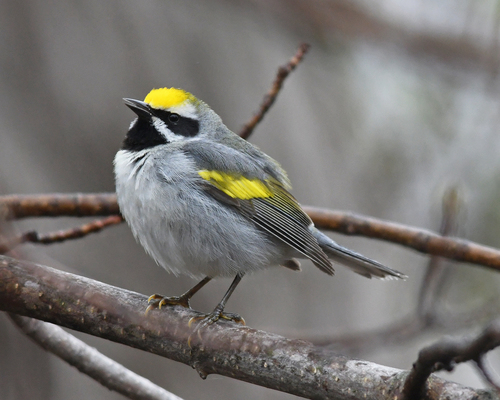
Golden-winged Warbler
Vermivora chrysoptera
A rare gem of the shrublands, the Golden-winged Warbler captivates with its striking yellow crown and sophisticated silver plumage. This long-distance traveler is a master of the forest edge, bringing a touch of gold to the wilder corners of your backyard.
Quick Identification
Size
Length: 4.3–5.1 in (11–13 cm); Wingspan: 7.1–7.9 in (18–20 cm); Weight: 0.28–0.35 oz (8–10 g)
Colors
Silvery-gray back and underparts with brilliant yellow patches on the crown and wings. Males feature a jet-black throat and eye mask, while females have a soft gray mask and throat.
Key Features
- Bright yellow crown and double wing bars
- Bold black throat and triangular eye mask (males)
- Silvery-gray upperparts and white belly
- Thin, pointed bill for probing foliage
When You’ll See Them
Geographic range
Where Does the Golden-winged Warbler Live?
The Golden-winged Warbler is native to North America, primarily breeding in two distinct populations within the Great Lakes region and the Appalachian Mountains. As a migratory species, it spends the winter months in Central America and the northern reaches of South America, specifically in countries like Colombia and Venezuela. While its range is currently expanding slightly northward into Canada, it is becoming increasingly rare in the southern and eastern portions of its traditional United States territory.
Basemap © OpenStreetMap contributors
Behavior
The Golden-winged Warbler is an energetic and acrobatic forager, often seen hanging upside down from the tips of branches to inspect the undersides of leaves. They use a specialized 'hang-and-probe' technique, where they use their sharp bills to open rolled-up leaves in search of hidden caterpillars. During the breeding season, males are highly territorial and can be found singing their distinctive, buzzy 'zee-za-za-za' song from high, exposed perches at the edges of their territories.
These birds are remarkably loyal to their breeding sites, often returning to the same patch of scrubby field year after year. While they are relatively shy around humans and prefer the cover of dense shrubs, they are not strictly 'deep forest' birds, favoring the messy, transitional zones where forests are regrowing. During migration, they may join mixed flocks with other warblers and chickadees, navigating thousands of miles between their North American breeding grounds and tropical wintering sites.
EverydayEarth exclusive
Camera Tips
To capture a Golden-winged Warbler on your backyard camera, you need to target 'edge' habitats. These birds avoid deep, dark forests and wide-open lawns, preferring the tangled mess of shrubs, saplings, and tall goldenrod. If your property has a transition zone where the woods meet a clearing, that is the prime location for your camera setup. Mounting your camera 3 to 5 feet off the ground is ideal, as these warblers spend much of their time foraging in the mid-story and low shrub layers.
One of the most effective ways to attract this species to a camera trap is the addition of a moving water feature. A solar-powered fountain or a simple 'dripper' over a shallow birdbath is irresistible to warblers, especially during the peak migration months of May and September. Position your camera about 4 to 6 feet away from the water source to ensure the bird fills enough of the frame, and use a high-speed trigger or 'Burst Mode' (3-5 photos per trigger) to catch their rapid, twitchy movements.
In late spring, look for 'song perches'—dead branches or high twigs that stick out above the surrounding scrub. Males will often return to the exact same twig every morning to sing. If you find a perch with small splashes of white droppings (bird lime), it’s a sign of a regular visitor. Aim your camera there with a fast shutter speed setting to freeze the action. Since they are insect-eaters, standard birdseed won't work as bait; instead, focus on planting native host plants like Goldenrod or Elderberry that naturally attract the caterpillars they crave.
Similar Species
Species that look similar or are commonly confused with Golden-winged Warbler.
Frequently Asked Questions
Record Golden-winged Warbler at your habitat
Connect a camera to start building your own species record — AI identifies every visitor automatically.