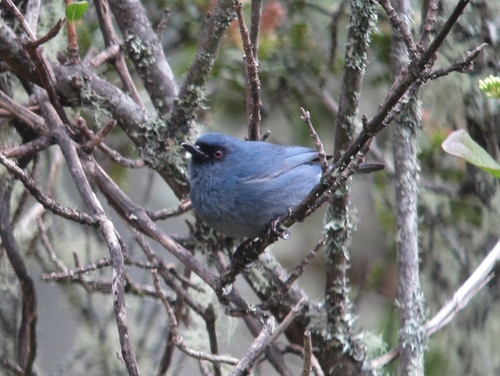
Bluish Flowerpiercer
Diglossa caerulescens
Master of the Andean heights, the Bluish Flowerpiercer is a clever 'nectar thief' with a uniquely hooked bill. This slate-blue beauty is a constant companion for those exploring the misty cloud forests of South America.
Quick Identification
Size
Length: 13–14 cm (5.1–5.5 in); Weight: 10–14 g (0.35–0.5 oz)
Colors
Dull slate-blue or bluish-grey body; brighter blue forehead and eyebrows; blackish face mask around the eyes; dark grey wings and tail.
Key Features
- Distinctive upturned bill with a sharp hook on the upper mandible
- Uniformly bluish-grey plumage with no heavy streaking
- Bright blue 'supercilium' (eyebrow) and forehead
- Active, restless movement through mid-level canopy
When You’ll See Them
Geographic range
Where Does the Bluish Flowerpiercer Live?
Native to the South American continent, the Bluish Flowerpiercer is a true specialist of the rugged Andean mountain chain. Its territory follows the spine of the Andes from the coastal cordilleras of Venezuela through the misty highlands of Colombia and Ecuador into the deep valleys of Peru and Bolivia. Because it thrives in the stable, humid conditions of the cloud forest, it is a permanent resident throughout its range, showing no need for long-distance migration.
Basemap © OpenStreetMap contributors
Behavior
The Bluish Flowerpiercer is a high-energy specialist of the Andean cloud forests. Unlike many of its more colorful tanager cousins, this bird is best known for its unique foraging technique called 'nectar robbing.' Instead of hovering like a hummingbird to reach nectar from the front of a flower, the flowerpiercer uses its specialized hooked bill to puncture the base of tubular blossoms, accessing the sweet rewards without providing any pollination services to the plant.
These birds are generally social and are frequently spotted as part of mixed-species foraging flocks, often traveling alongside other tanagers, warblers, and brush-finches. They are restless and fast-moving, rarely staying on one branch for more than a few seconds as they probe for insects or search for their next floral target. While they are not particularly shy, their preference for the mid-to-upper canopy and thick forest edges can make them a challenge to spot without a bit of patience.
EverydayEarth exclusive
Camera Tips
To capture the Bluish Flowerpiercer on camera, your best bet is to focus on their primary food source: tubular flowers. Look for native Andean plants like Fuchsia or Centropogon. If you are in their range, setting up your camera near a cluster of these blooming plants at the forest edge is far more effective than using a traditional bird feeder. Aim the camera at the base of the flowers, as this is where the bird will pause to 'pierce' the blossom, giving you a few seconds of stillness to capture a sharp image.
Because these birds inhabit misty montane environments, lighting can be tricky. Position your camera to take advantage of the brightest morning light (6-9 AM), when the birds are most active and searching for their first meal. If your camera allows for manual settings, use a high shutter speed—at least 1/1000th of a second—to freeze their quick, jerky movements. High-quality AI cameras with motion detection should be set to 'High Sensitivity' because of the bird's small size and rapid flight patterns.
Mount your camera at a height of 5 to 10 feet, ideally on a branch that overlooks a clear path to flowering shrubs. Since these birds are part of mixed flocks, you may find that capturing one species leads to a flurry of activity from others. Ensure your SD card has plenty of space and your batteries are fully charged, as a single flock passing through can trigger dozens of recordings in just a few minutes.
Similar Species
Species that look similar or are commonly confused with Bluish Flowerpiercer.
Masked Flowerpiercer
Features a much darker, more defined black mask on the face and often has more contrasting blue on the wings.
Glossy Flowerpiercer
Distinctly black plumage with a glossy sheen and a small white patch on the shoulder, unlike the uniform blue-grey of the Bluish.
Black Flowerpiercer
Entirely black plumage and lacks the bright blue forehead and eyebrows of the Bluish Flowerpiercer.
Frequently Asked Questions
Record Bluish Flowerpiercer at your habitat
Connect a camera to start building your own species record — AI identifies every visitor automatically.