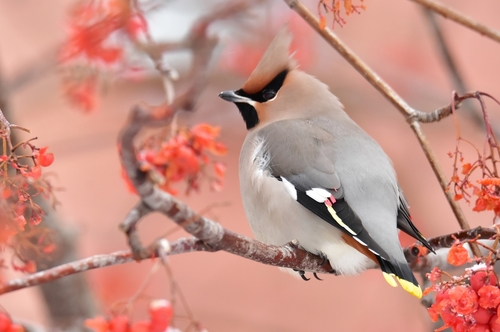
Bohemian Waxwing
Bombycilla garrulus
A social wanderer of the north, the Bohemian Waxwing is famous for its silky plumage and the vibrant, wax-like droplets on its wings. These elegant birds roam in large, trilling flocks, transforming winter backyards into lively hubs of activity.
Quick Identification
Size
Length: 19–23 cm (7.5–9 in); Wingspan: 32–36 cm (12.5–14 in); Weight: 45–70 g (1.6–2.5 oz)
Colors
Soft cinnamon-grey body with a peach-toned face; black mask and throat; yellow-tipped tail; wings patterned with white, yellow, and signature red 'waxy' tips. Sexes are virtually identical.
Key Features
- Prominent pointed crest
- Black mask extending through the eye to the back of the head
- Bright yellow band at the tip of the tail
- Small red droplets on secondary wing feathers resembling sealing wax
When You’ll See Them
Geographic range
Where Does the Bohemian Waxwing Live?
The Bohemian Waxwing is a wide-ranging traveler of the northern hemisphere, native to the vast boreal zones of North America and Eurasia. In the Western Hemisphere, they primarily breed in Alaska and northwestern Canada, while their Palearctic range spans from Scandinavia across the Russian taiga. During the winter, these nomadic flocks move south into the northern United States, Central Europe, and parts of East Asia, appearing wherever berry crops are most abundant.
Basemap © OpenStreetMap contributors
Behavior
Bohemian Waxwings are highly social, nomadic birds that spend most of the year in large, roving flocks. Unlike many songbirds, they are not strongly territorial and are known for their incredibly communal nature, often sitting shoulder-to-shoulder on branches while passing berries to one another. They are exceptionally fast flyers with a direct, starling-like flight pattern.
During the winter, these birds become 'irruptive' wanderers, traveling great distances in search of fruit. They are remarkably bold around humans, often allowing close approach when they are focused on feeding in backyard fruit trees. Their presence is usually announced by a high-pitched, silvery trill that sounds like a tiny bell ringing, a sound that can be quite loud when a flock of hundreds descends on a single tree.
EverydayEarth exclusive
Camera Tips
To capture these nomadic beauties, focus your camera efforts on fruit-bearing trees like Mountain Ash, Rowan, Crabapple, or Juniper during the winter months. Since waxwings travel in large flocks, place your camera at a wide-angle setting to capture the scale of the group rather than a single bird. Mounting your camera on a tall tripod or high fence post—roughly 6 to 10 feet off the ground—will help you get eye-level shots of them feeding in the lower branches of fruit trees.
One of the best ways to attract Bohemian Waxwings to your camera's field of view is a heated birdbath. Because their diet is so high in sugar from dried fruits, they need to drink and bathe frequently, even in sub-zero temperatures. Position the camera about 3-5 feet from the water source, facing north to avoid lens flare from the low winter sun. Use a fast shutter speed or high-frame-rate video setting, as these birds move quickly and their group dynamics are fascinating to watch in slow motion.
If you are using an AI-powered camera, ensure the motion sensitivity is set to high. Waxwings often hover briefly to pluck berries (gleaning), which can trigger a camera more effectively than a bird simply perched. In late winter, they may also be attracted to fermented fruit on the ground; placing a camera low to the ground near fallen apples can provide a unique perspective on their behavior, though you should be mindful of protecting the lens from moisture and debris.
Similar Species
Species that look similar or are commonly confused with Bohemian Waxwing.
Frequently Asked Questions
Record Bohemian Waxwing at your habitat
Connect a camera to start building your own species record — AI identifies every visitor automatically.