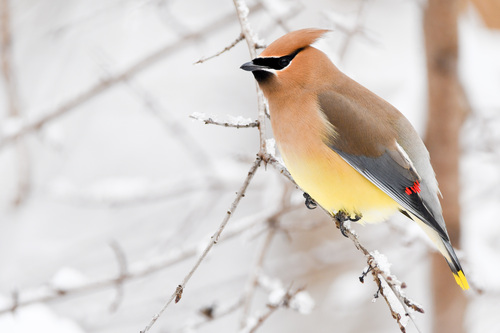
Cedar Waxwing
Bombycilla cedrorum
With their silky plumage and elegant black masks, Cedar Waxwings are the 'sophisticates' of the bird world. Often arriving in hungry, social flocks, these berry-loving beauties are a spectacular sight for any backyard observer.
Quick Identification
Size
Length: 15-18 cm (6-7 in); Wingspan: 22-30 cm (9-12 in); Weight: 30g (1.1 oz)
Colors
Silky tan-brown head and chest, soft gray wings and tail, and a pale yellow belly. They feature a crisp black mask and a bright yellow band at the tip of the tail.
Key Features
- Sleek, swept-back crest on the head
- Deep black mask across the eyes outlined in white
- Bright yellow band at the tip of the tail
- Red waxy tips on the secondary wing feathers
When You’ll See Them
Geographic range
Where Does the Cedar Waxwing Live?
Native to North America, the Cedar Waxwing enjoys an expansive range that stretches from the boreal forests of Canada down through the entire United States. While they breed across the northern half of the continent, they are nomadic winter travelers, often venturing as far south as Central America and the Caribbean in search of fruit. Because they follow ripening crops rather than strict migratory paths, their presence in any specific location can vary significantly from year to year.
Basemap © OpenStreetMap contributors
Behavior
Cedar Waxwings are exceptionally social birds, rarely seen alone. They move in large, fluid flocks that seem to ripple through the canopy as they forage for berries. They are famous for their unique social bonding rituals, such as 'passing the berry,' where individuals sitting in a row on a branch will pass a fruit back and forth down the line until one finally decides to eat it.
These birds are among the most specialized fruit-eaters in North America, often surviving for months on a fruit-only diet. Their arrival in a backyard is often sudden and dramatic; a hundred birds may descend on a single fruiting tree, stripping it clean of berries in a matter of hours before vanishing as quickly as they arrived. While they are generally shy around humans, their intense focus on feeding can allow for close observation if you remain still and quiet.
EverydayEarth exclusive
Camera Tips
To capture Cedar Waxwings on camera, focus your efforts on water sources rather than traditional seed feeders. These birds are highly attracted to birdbaths and fountains, especially those featuring moving or dripping water. Place your AI-powered camera 3 to 5 feet away from the water source, angled slightly downward to capture the reflections and the chaotic action as the entire flock descends to drink and bathe together.
If you have native berry-producing plants like Eastern Red Cedar, Serviceberry, or Crabapple in your yard, mount your camera directly to a nearby branch or use a tripod focused on a cluster of ripening fruit. Use a high-speed trigger or 'Burst Mode' if available; waxwings move incredibly fast when feeding, and you’ll want to capture the moment they toss a berry into the air before swallowing it. Video mode is also excellent for recording their high-pitched, thin whistling calls.
Because Cedar Waxwings are social, one bird usually signals the arrival of dozens. Set your camera for daylight optimization, and if you can manually adjust settings, aim for a fast shutter speed (1/1000s or higher) to freeze the motion of their wings. During late winter and early spring, keep your cameras active even in the cold, as these birds are often the most frequent visitors to backyards when other food sources are scarce and they are searching for fermented berries.
Similar Species
Species that look similar or are commonly confused with Cedar Waxwing.
Frequently Asked Questions
Record Cedar Waxwing at your habitat
Connect a camera to start building your own species record — AI identifies every visitor automatically.