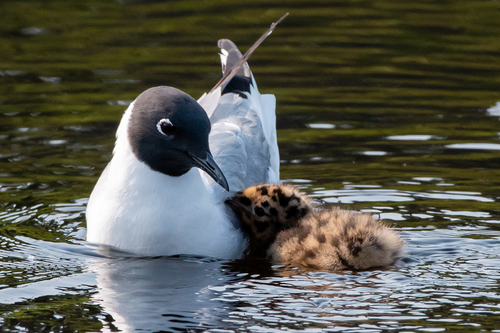
Bonaparte's Gull
Chroicocephalus philadelphia
An elegant, tern-like gull known for its striking black hood and the remarkable habit of nesting in evergreen trees across the northern wilderness.
Quick Identification
Size
Length: 28–38 cm (11–15 in); Wingspan: 76–84 cm (30–33 in); Weight: 180–225 g (6.3–7.9 oz)
Colors
White body and tail with pale grey wings; adults have a slaty-black hood in summer and a black ear-spot in winter; black bill and bright orange-red legs.
Key Features
- Slaty-black hood during breeding season
- Small black spot behind the eye in non-breeding plumage
- Translucent white 'wedges' on outer wing tips
- Thin, needle-like black bill
When You’ll See Them
Geographic range
Where Does the Bonaparte's Gull Live?
Native to North America, the Bonaparte's Gull follows a vast migratory path that stretches from the subarctic to the subtropics. They spend their summers breeding in the boreal forests of Alaska and across nearly all of Canada. As winter approaches, they move south to inhabit the Atlantic and Pacific coasts of the United States, the Gulf of Mexico, and parts of the Caribbean, making them a common sight for birdwatchers across the continent during their seasonal transit.
Basemap © OpenStreetMap contributors
Behavior
During the non-breeding season, these gulls are highly social and can be found in large flocks along coastlines and Great Lakes shorelines. They are surface-feeders, frequently hovering just above the water to pluck small fish or insects from the surface. While they are vocal, their calls are a distinctive rasping 'cheer' or 'wheer,' which is much softer and less raucous than the screams of a Herring Gull.
EverydayEarth exclusive
Camera Tips
To capture high-quality images of Bonaparte's Gulls, position your camera near shorelines or mudflats during the peak migration windows in spring and autumn. Because these gulls are smaller and lower to the ground than other species, a low-angle camera mount (around 12 to 18 inches) is ideal. This perspective captures the bird at eye level, providing a much more intimate look at their delicate facial features and bright red legs.
Since they are primarily surface feeders and insect hunters, they aren't attracted to standard birdseed. However, if you are setting up a camera on a private dock or shoreline, look for areas where small fish congregate or where aquatic insects are hatching. A camera with a fast trigger speed is essential, as these birds are fast and spend much of their time in flight or hovering briefly over the water's surface.
Pay close attention to lighting. Their white plumage can easily become 'blown out' or overexposed in harsh midday sun. Set your camera to be active during the golden hours of early morning or late afternoon. If your camera allows for exposure compensation, a setting of -0.3 or -0.7 can help preserve the detail in their white feathers. In their northern breeding range, you might even find success pointing a trail camera toward the mid-canopy of spruce trees near water, though their nests are notoriously difficult to spot.
Similar Species
Species that look similar or are commonly confused with Bonaparte's Gull.
Franklin's Gull
Has a thicker, darker red bill and a more extensive black pattern on the wingtips with prominent white spots.
Little Gull
The world's smallest gull, it lacks the white wing wedges of the Bonaparte's and has distinctive dark charcoal underwings.
Black-headed Gull
Slightly larger with a dark chocolate-brown hood (rather than black) and a dark red bill.
Frequently Asked Questions
Record Bonaparte's Gull at your habitat
Connect a camera to start building your own species record — AI identifies every visitor automatically.