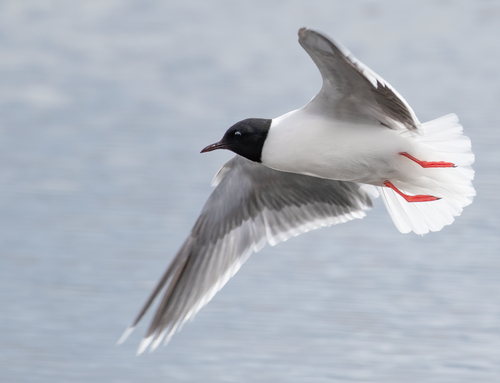
Little Gull
Hydrocoloeus minutus
The world's smallest gull is a masterpiece of avian grace, combining the elegance of a tern with the resilience of a seabird. Known for its striking black hood and ink-dark underwings, this tiny traveler is a rare prize for any backyard observer near the water's edge.
Quick Identification
Size
Length: 25-30 cm (10-12 in); Wingspan: 61-78 cm (24-31 in); Weight: 68-162 g (2.4-5.7 oz)
Colors
Adult breeding: Jet-black hood, pale grey upperparts, white underparts with a pinkish flush, and distinctive dark sooty-black underwings. Non-breeding adults lose the hood, retaining a dark ear spot.
Key Features
- World's smallest gull species
- Distinctive jet-black hood in breeding plumage
- Sooty-black wing linings visible in flight
- Small, thin black bill and reddish legs
- Buoyant, tern-like flight pattern
When You’ll See Them
Geographic range
Where Does the Little Gull Live?
The Little Gull is primarily a Palearctic species, with its core breeding grounds spanning from Northern and Eastern Europe across Siberia to Mongolia. In North America, small but stable populations breed in the Great Lakes region and around Hudson Bay. These migratory birds travel south to spend their winters along the Mediterranean, the Caspian Sea, and the Atlantic coastlines of North America and Western Europe.
Basemap © OpenStreetMap contributors
Behavior
Little Gulls are remarkably graceful flyers, often exhibiting a buoyant, dipping flight pattern that more closely resembles a tern than a typical seagull. They are highly social birds, particularly during the breeding season when they form colonies in marshes and wetlands, often nesting alongside Black-headed Gulls or Common Terns for shared protection against predators.
Unlike many of their larger relatives that scavenge for scraps, Little Gulls are primarily insectivorous during the summer. They are skilled at plucking insects directly from the air or delicately dipping to the water's surface to grab prey. While they are generally shy around humans, they can be observed in relatively close proximity at popular birding hotspots during migration, where they may stop to rest on piers or sandy shorelines.
EverydayEarth exclusive
Camera Tips
To capture the world's smallest gull on a wildlife camera, location is everything. These birds rarely stray far from water, so focus your efforts on property bordering freshwater marshes, lake edges, or coastal estuaries. Use a low-profile stake or tripod to position your camera just 12 to 24 inches above the ground, facing a frequent 'loafing' spot like a flat rock, a partially submerged log, or a sandy spit where gulls gather to preen.
Because Little Gulls are fast and erratic flyers, set your camera to a high-speed burst mode if available. Increasing the trigger sensitivity is essential to ensure the camera catches their light, buoyant movements. If your camera allows for manual shutter speed settings, aim for 1/1000s or faster to freeze the action of their wings, especially to capture the distinctive dark underwings that identify this species.
Since they are primarily insect-eaters, standard birdseed won't work. Instead, focus on 'natural baiting' by maintaining a healthy, chemical-free shoreline that attracts dragonflies and other aquatic insects. The best time for photography is during the spring migration in May or late summer in August. Early morning light is preferred, as it highlights the subtle pinkish flush on their white breasts and provides the contrast needed to see their dark wing linings against the sky or water.
Similar Species
Species that look similar or are commonly confused with Little Gull.
Bonaparte's Gull
Slightly larger with a thicker bill and pale wing linings compared to the Little Gull's dark underwings.
Black-headed Gull
Significantly larger with a chocolate-brown hood (rather than jet black) and red bill and legs.
Common Tern
Similar size and flight but features a deeply forked tail, a long orange-red bill with a black tip, and lacks the full hood.
Frequently Asked Questions
Record Little Gull at your habitat
Connect a camera to start building your own species record — AI identifies every visitor automatically.