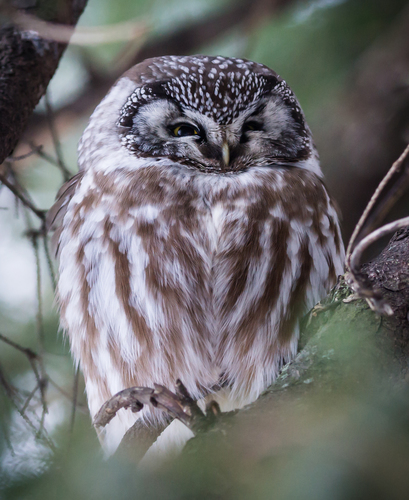
Boreal Owl
Aegolius funereus
A silent ghost of the subarctic, the Boreal Owl is a master of the night. With its piercing yellow eyes and square-shaped head, this elusive raptor thrives in the world's most rugged northern forests.
Quick Identification
Size
Length: 22-27 cm (8.7-10.6 in) | Wingspan: 50-62 cm (20-24 in) | Weight: 90-195 g (3.2-6.9 oz)
Colors
Chocolate brown upperparts with white spots; white facial disc with a thick black border; grayish-white underparts with thick brown streaks; bright yellow eyes.
Key Features
- Distinctive white spotting on a large, square-shaped forehead
- Bright yellow iris with a stark black frame around the facial disc
- Stocky, compact body with no ear tufts
When You’ll See Them
Geographic range
Where Does the Boreal Owl Live?
The Boreal Owl enjoys a vast circumpolar distribution across the northernmost reaches of the Northern Hemisphere. It is native to the expansive forests of Alaska and Canada in North America, as well as the broad taiga belt of Russia, Scandinavia, and Northern China in Eurasia. In more temperate regions like the contiguous United States and Central Europe, it is found primarily in high-altitude mountain ranges where the climate mimics the subarctic conditions of the north.
Basemap © OpenStreetMap contributors
Behavior
The Boreal Owl is an exceptionally secretive and strictly nocturnal hunter, spending its daylight hours roosting in the densest cover of coniferous trees. Because of its quiet nature and remote habitat, it is often considered one of the most difficult owls to spot in the wild. It is a sit-and-wait predator, typically perching on low branches to scan for movement. Its hearing is so acute that it can locate prey moving beneath several inches of snow or dense leaf litter before launching a silent strike.
During the breeding season, males become nomadic and highly vocal, using a series of rapid, staccato hoots to defend territories and attract mates. Unlike many other owls, the Boreal Owl does not build its own nest, instead relying on the abandoned cavities of large woodpeckers or natural hollows. While they are generally solitary, they are known for their 'nomadic' tendencies, moving long distances between years based on the fluctuating population of small rodents.
EverydayEarth exclusive
Camera Tips
Capturing a Boreal Owl on a trail camera requires patience and strategic placement in old-growth coniferous forests. Look for areas with a high density of snags (standing dead trees), especially those with large woodpecker holes, as these are the owl's primary nesting and roosting sites. Mount your camera 8 to 10 feet up a tree, facing a known cavity or a clear horizontal branch that could serve as a hunting perch. An upward angle toward a cavity entrance or a downward angle toward a forest clearing edge works best.
Because these birds are strictly nocturnal, your camera's infrared (IR) flash performance is the most critical factor. Use 'No-Glow' IR flash settings if possible to avoid spooking the bird or attracting larger predators to the nest site. Boreal Owls are most active during the late winter and early spring (February through May) when males are establishing territories. Setting your camera to 'Burst Mode' or 'Photo + Video' is highly recommended, as it allows you to capture the quick, silent landing and the subsequent scanning behavior of the owl.
If you are looking to attract them to a specific backyard or trail area, installing a dedicated owl nesting box (sized for Boreal or Screech owls) is the most effective method. Line the bottom with a few inches of wood shavings to mimic a natural cavity. Place the camera on a nearby tree focused directly on the box's entrance. Be sure to check your trigger speed settings; a slow trigger will result in 'empty' photos of a bird that has already flown out of the frame.
Similar Species
Species that look similar or are commonly confused with Boreal Owl.
Northern Saw-whet Owl
Smaller with a dark beak and white vertical forehead streaks, whereas the Boreal Owl has a light beak and white forehead spots.
Little Owl
Found in more open habitats across Europe and Asia; it has a flatter head profile and lacks the Boreal Owl's distinct black-framed facial disc.
Frequently Asked Questions
Record Boreal Owl at your habitat
Connect a camera to start building your own species record — AI identifies every visitor automatically.