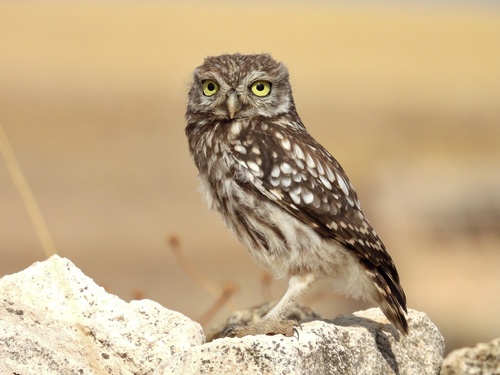
Little Owl
Athene noctua
The Little Owl is the pint-sized 'Owl of Athena,' a fierce and charismatic bird often seen sunbathing on fence posts during the day. With its striking yellow eyes and signature head-bob, it is one of the most rewarding species to discover in a backyard or rural garden.
Quick Identification
Size
Length: 21-23 cm (8.3-9.1 in); Wingspan: 50-56 cm (20-22 in); Weight: 140-200 g (4.9-7.1 oz)
Colors
Mottled grey-brown upperparts with white streaks and spots; pale underparts with dark brown vertical streaks. Distinctive white 'eyebrows' and bright yellow irises.
Key Features
- Compact, flat-headed profile with piercing yellow eyes
- Mottled grey-brown plumage with heavy white spotting
- Frequent head-bobbing and bowing behavior when alert
- Low, undulating flight pattern similar to a woodpecker
When You’ll See Them
Geographic range
Where Does the Little Owl Live?
The Little Owl is native to a vast region spanning the temperate and warmer parts of Europe, North Africa, and the Palearctic east through Central Asia to Korea and China. It is particularly well-established in Mediterranean climates but has adapted to various environments. While not native to the British Isles, it was successfully introduced to the United Kingdom in the late 19th century and has since become a staple of the English countryside. Additionally, an introduced population thrives on the South Island of New Zealand, having been brought there in the early 20th century to control insect pests.
Basemap © OpenStreetMap contributors
Behavior
The Little Owl is a remarkably charismatic raptor that breaks the typical owl mold by being frequently active during the day. Unlike its more secretive cousins, it can often be seen basking in the sun on a prominent perch, such as a fence post, telegraph pole, or a gnarled branch of an old fruit tree. They are highly territorial and sedentary birds, often spending their entire lives within a small range of their birthplace, usually living in pairs that defend their territory year-round.
When these owls feel threatened or curious, they perform a comical 'bobbing' display, rapidly moving their heads up and down and side to side to gain better depth perception. While they are capable hunters, they are also quite social with their mates, frequently engaging in mutual preening near their roosting sites. Their presence is often announced by a variety of vocalizations, ranging from a sharp, barking 'kiew-kiew' to a more melodic, rising whistle heard most frequently during the spring breeding season.
EverydayEarth exclusive
Camera Tips
To capture the Little Owl on your backyard camera, you should focus on their preferred 'lookout' spots. These owls are creatures of habit and will return to the same fence post, gate, or stone wall every day to scan for prey. Place your camera 3 to 5 feet off the ground, facing a known perch from about 10 feet away. If you don't have a natural perch, a simple wooden post driven into the ground in an open area of the garden can act as a magnet for them. Use a 'no-glow' or 'black' infrared flash to ensure you don't startle the owl during its low-light hunting sessions.
Because Little Owls hunt extensively on the ground for beetles and worms, they are particularly attracted to areas with short, managed grass. If your camera is near a vegetable patch or a freshly mown lawn, you have a higher chance of catching them in action. You can encourage visits by maintaining a 'bug-friendly' zone like a log pile or bug hotel nearby, which provides a natural food source that will keep the owl returning to the same spot night after night.
Set your camera to take short video clips (10-15 seconds) rather than just photos. This will allow you to see their unique behaviors, such as the characteristic head-bobbing or the way they run across the ground on their long legs to catch insects. In the spring, pay close attention to old hollow trees or holes in stone walls; if you find a nesting site, place your camera at a respectful distance to capture the parents bringing food to the fluffy, white-flecked fledglings who often sit outside the nest entrance during the day.
Similar Species
Species that look similar or are commonly confused with Little Owl.
Eurasian Scops Owl
The Scops Owl has visible 'ear' tufts and more bark-like, camouflaged plumage compared to the spotted Little Owl.
Tawny Owl
Much larger than the Little Owl, with a rounder head and large, dark black eyes rather than yellow.
Boreal Owl
Also known as Tengmalm's Owl, it has a much whiter facial disc and is strictly nocturnal, found mostly in dense coniferous forests.
Frequently Asked Questions
Record Little Owl at your habitat
Connect a camera to start building your own species record — AI identifies every visitor automatically.