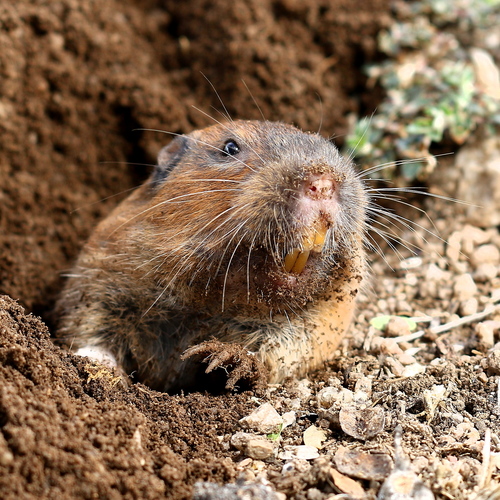
Botta's Pocket Gopher
Megascapheus bottae
The ultimate subterranean architect of the West, Botta's Pocket Gopher is a master of transformation, turning soil and shaping ecosystems from beneath our feet.
Quick Identification
Size
Total length: 12-25 cm (5-10 inches); Weight: 110-250 g (4-9 oz)
Colors
Highly variable coat color ranging from cinnamon and chocolate brown to pale grey or nearly black, typically matching the local soil color.
Key Features
- External fur-lined cheek pouches used for transporting food
- Large, powerful front claws adapted for digging
- Small eyes and ears suited for subterranean life
- Large yellowish incisors that remain visible even when the mouth is closed
When You’ll See Them
Geographic range
Where Does the Botta's Pocket Gopher Live?
Botta's Pocket Gopher is native to the western regions of North America, spanning from the Pacific Coast into the interior deserts. Its primary range is concentrated in the Southwestern United States, including California, Arizona, New Mexico, Nevada, and parts of Utah, Colorado, and Texas. The species also extends deep into Northern Mexico, including the Baja Peninsula and the states of Sonora and Chihuahua, where it thrives from coastal beaches to high-altitude mountain meadows.
Basemap © OpenStreetMap contributors
Behavior
Botta's Pocket Gophers are solitary, industrious engineers that spend the vast majority of their lives in complex underground tunnel systems. They are fiercely territorial and will defend their burrows against any intruders, including other gophers, except during the brief mating season. Their burrow systems are sophisticated, featuring separate chambers for nesting, food storage, and waste management, often spanning over 100 feet in length.
While they are rarely seen above ground, their presence is signaled by the characteristic crescent-shaped mounds of soil they push to the surface. These gophers are remarkably adapted for digging; they use their powerful front limbs and even their teeth to move earth. Because they are a key prey species for predators like owls, hawks, and snakes, they are extremely cautious when venturing to the surface, often only emerging far enough to grab a nearby plant before retreating backward into the safety of their tunnel.
EverydayEarth exclusive
Camera Tips
Capturing a Botta's Pocket Gopher on camera requires patience and a focus on 'fresh' activity. Look for a mound where the soil is still moist and dark—this indicates a gopher is currently working nearby. Instead of pointing the camera at the top of the mound, aim it at the 'plug,' which is the circular depression where the gopher actually exits. Use a ground-level stake or a very low-profile mount to get an eye-level view, as these animals rarely stand more than a few inches off the ground.
Because gophers are incredibly fast and only emerge for seconds at a time to clip vegetation, set your camera to its fastest trigger speed and use 'Burst Mode' or 'Rapid Fire' to take 3-5 photos per trigger. If your camera supports it, high-frame-rate video is even better for capturing the quick 'grab-and-dash' feeding behavior. Since they are active both day and night, ensure your camera has a high-quality infrared (no-glow) flash to avoid scaring them during nocturnal foraging.
Avoid placing the camera too close—about 3 to 5 feet is usually the sweet spot for focus and field of view. You can encourage an appearance by placing a small piece of fresh carrot or a dandelion green just outside the plugged entrance, but be careful not to disturb the mound too much, or the gopher may simply backfill the tunnel and abandon that exit entirely. Check your camera daily, as gophers can quickly cover a camera lens with fresh dirt if they decide to expand their mound in that direction.
Similar Species
Species that look similar or are commonly confused with Botta's Pocket Gopher.
Frequently Asked Questions
Record Botta's Pocket Gopher at your habitat
Connect a camera to start building your own species record — AI identifies every visitor automatically.