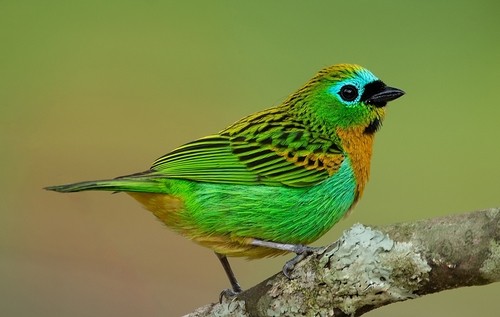
Brassy-breasted Tanager
Tangara desmaresti
Draped in metallic green and shimmering gold, the Brassy-breasted Tanager is a radiant endemic of Brazil's misty mountains. This social bird brings a splash of high-altitude color to the forest canopy and backyard feeders alike.
Quick Identification
Size
Length: 13-14 cm (5.1-5.5 in); Weight: 19-22 g (0.67-0.78 oz)
Colors
Metallic green upperparts, vibrant brassy-yellow breast, rufous-orange forehead, and a blue-violet wash on the crown and nape. Both sexes look similar.
Key Features
- Metallic yellow-gold breast and belly
- Bright orange-red forehead and lores
- Rich blue-violet crown and nape
- Small, triangular black throat patch
When You’ll See Them
Geographic range
Where Does the Brassy-breasted Tanager Live?
Native to the South American continent, the Brassy-breasted Tanager is a proud endemic of Brazil's coastal mountains. It is primarily found within the lush Atlantic Forest biome, specifically in the southeastern states of Espírito Santo, Minas Gerais, Rio de Janeiro, São Paulo, and Paraná. This species is a high-altitude specialist, rarely found in the lowlands, and there are no known introduced populations elsewhere in the world.
Basemap © OpenStreetMap contributors
Behavior
The Brassy-breasted Tanager is a highly social and energetic bird, known for its participation in vibrant mixed-species flocks. These groups often move through the upper canopy of the Atlantic Forest, searching for food with a restless, hopping motion. Despite their preference for high-altitude forests, they are quite bold and can be observed at various heights when fruit is abundant or when visiting bird feeders.
Interaction with humans is generally passive; they are comfortable visiting gardens and orchards in suburban areas adjacent to their forest habitats. Their social structure revolves around small family units that communicate with constant, high-pitched metallic 'seee' calls, ensuring the flock stays coordinated as they navigate the dense, misty foliage of the Brazilian mountains.
EverydayEarth exclusive
Camera Tips
To capture the stunning iridescent feathers of the Brassy-breasted Tanager, position your AI-powered camera near a platform feeder or a known fruiting tree like a wild guava or melastome. These birds are most active in the early morning light when the mist is still clearing from the Atlantic Forest slopes. Setting your camera at a height of 5 to 7 feet on a sturdy branch or post will align perfectly with their preferred mid-story foraging level.
In terms of bait, nothing beats over-ripe bananas, halved papayas, or oranges. These birds are highly sugar-motivated and will return frequently to a reliable fruit source. If you are setting up in a backyard, ensure the feeder is located near dense shrubbery; this provides them with a quick escape route from predators, making them feel secure enough to linger long enough for a clear shot.
Technically, you'll want to use a high-speed trigger and a fast shutter speed setting if your camera allows it. These tanagers are quick and prone to sudden, jerky movements that can cause motion blur. To get the best colors, aim for a spot that receives dappled morning sunlight; direct midday sun can wash out the metallic sheen of their green and gold plumage. During the cooler months (June to August), they often descend slightly to lower elevations, making it the prime season for backyard sightings in mountain towns.
Similar Species
Species that look similar or are commonly confused with Brassy-breasted Tanager.
Gilt-edged Tanager
Lacks the distinct orange forehead and has a more uniform yellow-gold face and throat.
Burnished-buff Tanager
Has a distinct black face mask and much paler, buffy-colored underparts compared to the metallic green/gold of the Brassy-breasted.
Green-headed Tanager
Features a much brighter blue/green head and a broad orange-red band on the lower back, lacking the brassy yellow breast.
Frequently Asked Questions
Record Brassy-breasted Tanager at your habitat
Connect a camera to start building your own species record — AI identifies every visitor automatically.