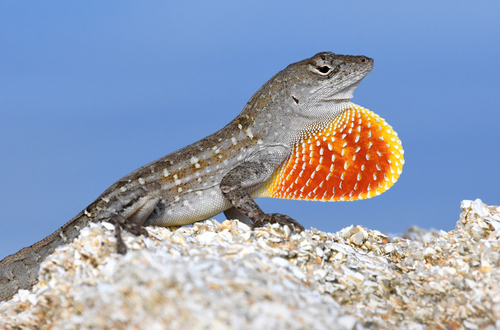
Brown Anole
Anolis sagrei
The Brown Anole is the charismatic acrobat of the suburban garden, known for its bold displays and lightning-fast reflexes. A master of adaptation, this small lizard has become a familiar neighbor for millions across the Americas and beyond.
Quick Identification
Size
12-20 cm (5-8 inches) in total length, including the tail; typically weighs between 2-8 grams.
Colors
Primary colors range from tan and light brown to charcoal grey; females often display a light-colored zig-zag or diamond pattern on the back, while males feature a vibrant reddish-orange dewlap with a yellow border.
Key Features
- Distinctive orange-red dewlap (throat fan) in males
- Zig-zag or diamond-shaped markings along the spine of females and juveniles
- Short, blunt snout compared to other anole species
- Toepads with specialized scales for vertical climbing
- Commonly seen in a 'head-down' perching position
When You’ll See Them
Geographic range
Where Does the Brown Anole Live?
Native to the islands of the Caribbean, including Cuba and the Bahamas, the Brown Anole has successfully colonized vast stretches of the Americas and beyond. It is now the most frequently spotted lizard in Florida and has established permanent populations throughout the coastal Southeastern United States, from Texas to North Carolina. Beyond North America, this resilient species has been introduced to parts of Hawaii, Southern California, Taiwan, and Singapore, often traveling as 'hitchhikers' in the soil of nursery plants.
Basemap © OpenStreetMap contributors
Behavior
The Brown Anole is a highly active and territorial lizard that has become a staple of suburban wildlife watching. Unlike many reptiles that shy away from human activity, these lizards are quite bold, often seen basking on fence posts, patio furniture, or low-lying tree trunks. They are primarily terrestrial or 'trunk-ground' dwellers, meaning they spend most of their time within a few feet of the earth rather than high in the canopy. Males are particularly famous for their territorial displays, which involve a series of 'push-ups' and the rhythmic flaring of their colorful dewlap to ward off rivals or attract mates.
These lizards are opportunistic hunters with a sit-and-wait foraging strategy. They will sit motionless on a perch until an insect moves nearby, then strike with lightning speed. They are also known for their 'autotomy'—the ability to drop their tail when grabbed by a predator. While they are generally solitary, you will often find multiple individuals in a single garden, each maintaining a small, defended territory. Their interactions with humans are usually neutral, though they are quick to dart into the bushes if approached too closely.
EverydayEarth exclusive
Camera Tips
To capture high-quality footage of a Brown Anole, you should position your camera at a low angle, roughly 12 to 24 inches off the ground. These lizards have a preference for vertical 'display posts,' so look for them on the sides of tree trunks, fence slats, or even the legs of garden tables. If you notice a male frequently bobbing his head in a specific spot, that is his territory; mount your camera there, as he is guaranteed to return to that exact perch throughout the daylight hours.
Since these are cold-blooded creatures, timing is everything. They are most photogenic in the mid-morning when the sun first hits their basking spots. During this time, they are trying to raise their body temperature and will remain still for longer periods, providing excellent opportunities for clear, sharp images. Set your camera's trigger speed to its fastest setting, as their movements—especially when hunting—are incredibly fast and can easily become a blur.
For the most impressive shots, try to capture the 'dewlap flare.' You don't need bait for this, as the behavior is social, but placing a small, shallow water dish nearby can attract both the lizard and the insects it eats, increasing the dwell time in front of your lens. Avoid placing the camera in deep shade; these lizards seek out dappled sunlight, and the extra light will help your AI camera pick up the fine details of their scales and the vibrant orange of the male's throat fan.
Similar Species
Species that look similar or are commonly confused with Brown Anole.
Frequently Asked Questions
Record Brown Anole at your habitat
Connect a camera to start building your own species record — AI identifies every visitor automatically.