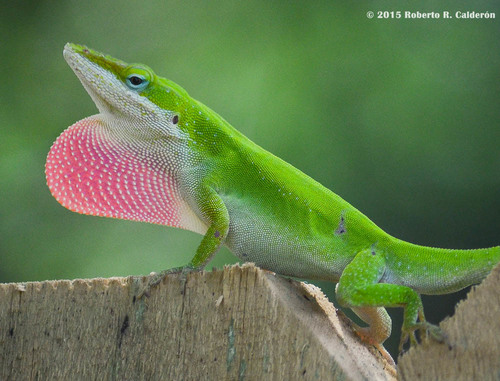
Green Anole
Anolis carolinensis
Meet the 'American Chameleon,' a color-shifting gymnast that brings a touch of the prehistoric to your garden. Watch as the Green Anole displays its brilliant red dewlap and hunts with precision among the leaves.
Quick Identification
Size
5-8 inches (13-20 cm) in length; weighs 2-6 grams
Colors
Vibrant emerald green to dark muddy brown; males feature a bright pink or red throat fan (dewlap)
Key Features
- Slender body with a long, pointed snout
- Ability to change color from green to brown in seconds
- Pink or red extendable dewlap in males
- Adhesive toe pads for climbing vertical surfaces
When You’ll See Them
Geographic range
Where Does the Green Anole Live?
Native to the North American continent, the Green Anole is the only species of anole indigenous to the United States. Its primary range covers the southeastern U.S., stretching from North Carolina down through the entirety of Florida and westward into the gulf states as far as Texas and Oklahoma. This adaptable lizard has also successfully established introduced populations on several islands, including Hawaii, the Bahamas, and even parts of Japan and the Ogasawara Islands.
Basemap © OpenStreetMap contributors
Behavior
Green Anoles are highly active, diurnal lizards known for their impressive arboreal acrobatics. They spend much of their day patrolling vertical territories, from tree trunks to garden fences, in search of prey or mates. While often called 'American Chameleons' because of their ability to shift color, this change is actually triggered by temperature, humidity, and emotional state rather than a direct attempt at camouflage. A stressed or cold anole typically turns dark brown, while a warm, active one displays a brilliant green.
Socially, these lizards are quite territorial, especially the males. You can often witness their elaborate communication displays, which involve rhythmic head-bobbing and the rhythmic extension of their colorful dewlap. While they are generally wary of humans and will scurry away if approached too quickly, they are harmless and play a vital role in controlling backyard insect populations.
EverydayEarth exclusive
Camera Tips
To capture high-quality footage of Green Anoles, focus on vertical real estate. These lizards are 'trunk-crown' specialists, meaning they prefer climbing surfaces over open ground. Mount your AI camera 3 to 5 feet high on a wooden fence post, a trellis, or the trunk of a broad-leafed tree like a Magnolia or Hibiscus. Aim the lens at a slight downward angle toward a sun-drenched leaf or branch where they are likely to bask in the morning.
Lighting is the most critical factor for these cold-blooded subjects. Position your camera to face southeast to catch the early morning rays. This is when anoles are most stationary as they 'charge' their bodies for the day, providing the perfect window for clear, focused shots before they become too fast and flighty. If your camera has a 'macro' or 'close-focus' setting, use it; anoles are small, and a standard wide-angle trail cam might miss the intricate details of their scales or the pulsing of their dewlap.
While you should avoid using food lures that might disrupt their natural diet, water is an excellent attractant. Use a misting system or a simple drip bottle over a broad leaf within the camera's field of view. Green Anoles prefer to lick droplets of water off foliage rather than drinking from a bowl. A 'burst mode' or high-frame-rate video setting is recommended to capture their lightning-fast predatory strikes on insects.
During the spring and early summer breeding season, look for 'display hubs.' Males often return to the same prominent branch or fence cap to perform their dewlap displays. Once you identify a male's favorite stage, keep your camera there for several days to document the territorial displays and courtship rituals that define their social lives.
Similar Species
Species that look similar or are commonly confused with Green Anole.
Frequently Asked Questions
Record Green Anole at your habitat
Connect a camera to start building your own species record — AI identifies every visitor automatically.