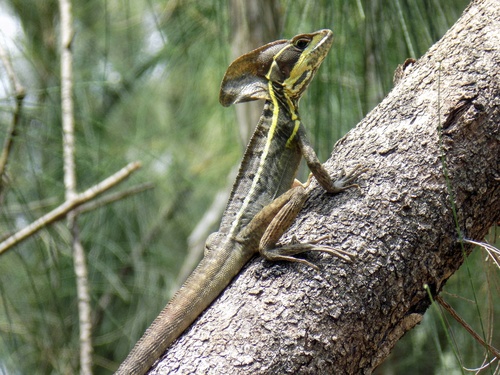
Brown Basilisk
Basiliscus vittatus
Known as the 'Jesus Christ Lizard' for its ability to run on water, the Brown Basilisk is a prehistoric-looking marvel of the reptile world. Whether basking on a canal bank or sprinting across a pond, this crested lizard is a spectacular sight in any tropical backyard.
Quick Identification
Size
30-61 cm (12-24 inches) in length, with the tail accounting for nearly two-thirds of the total body length; weight ranges from 200-600g.
Colors
Brown or olive-brown base with yellow or cream longitudinal stripes running down the sides; males feature prominent crests on the head, back, and tail.
Key Features
- Distinctive triangular head crest (larger in males)
- Two or three yellow stripes along the body
- Long, thin toes with fringe-like scales
- Extraordinarily long, slender tail
When You’ll See Them
Geographic range
Where Does the Brown Basilisk Live?
The Brown Basilisk is native to the Neotropical realms of North and Central America, with a natural range extending from central Mexico down through the Isthmus of Panama into northwestern Colombia. In recent decades, this resilient species has successfully established itself as an introduced species in the United States, specifically across southern and central Florida. They thrive in these warm, humid environments where man-made canals and lakes provide the perfect substitute for their native tropical riverbanks.
Basemap © OpenStreetMap contributors
Behavior
The Brown Basilisk is a highly active, semi-aquatic lizard most famous for its 'miraculous' ability to run across the surface of the water. When startled, it rises onto its hind legs and sprints across the water's surface, using specialized flaps on its toes to trap air bubbles that provide buoyancy. This bipedal locomotion allows them to escape predators that cannot follow them into open water.
Beyond their aquatic acrobatics, these lizards are primarily arboreal and terrestrial, spending much of their day basking on low-hanging branches or foraging in the leaf litter near water sources. They are wary and quick to flee, making them a challenge to approach. In suburban environments, they have become quite bold, often seen scurrying across sidewalks or garden walls before diving into a nearby canal or pond.
EverydayEarth exclusive
Camera Tips
To capture the Brown Basilisk on your backyard camera, location is everything. These lizards are highly predictable baskers; they require sunlight to regulate their body temperature and will often return to the same flat rock, fallen log, or low branch every morning. Position your camera 6 to 12 inches off the ground, aimed at a sunny spot within 5 feet of a water source like a pond or canal bank. Use a wide-angle setting if possible to capture their dramatic movement if they decide to sprint.
Because the Brown Basilisk is lightning-fast, you must set your camera to its highest trigger speed and shortest PIR (Passive Infrared) interval. A delay of even half a second might result in a photo of a disappearing tail. If your camera supports 'burst mode' or high-frame-rate video, enable it. These lizards are often triggered by the movement of insects, so placing your camera near flowering plants that attract butterflies and grasshoppers will naturally bring the basilisk into your frame of view.
Avoid placing the camera in heavy shade, as the Brown Basilisk's brown and olive scales provide excellent camouflage against dark earth and mulch. Bright, indirect morning light is the 'golden hour' for these reptiles, providing enough contrast to highlight their yellow stripes and the male's impressive dorsal crest. If you are using a trail camera in a public waterway or canal, ensure it is well-secured and camouflaged from human passersby, as these are high-traffic areas for both lizards and people.
Similar Species
Species that look similar or are commonly confused with Brown Basilisk.
Frequently Asked Questions
Record Brown Basilisk at your habitat
Connect a camera to start building your own species record — AI identifies every visitor automatically.