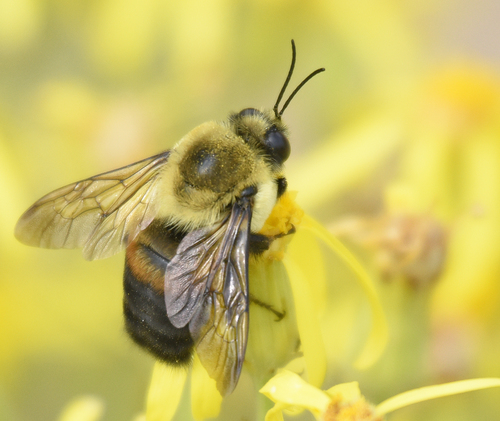
Brown-belted Bumble Bee
Bombus griseocollis
A hardy and adaptable pollinator, the Brown-belted Bumble Bee is a welcome sight in North American gardens. Known for its distinctive rusty-colored band and industrious nature, it is one of the most common bumblebees you'll spot on your backyard camera.
Quick Identification
Size
Queens: 20-23 mm (0.8-0.9 in); Workers: 9-15 mm (0.35-0.6 in); Males: 15-19 mm (0.6-0.75 in)
Colors
Black and yellow with a distinctive brownish-yellow or 'rusty' crescent on the second abdominal segment; males have noticeably larger eyes than females.
Key Features
- Brownish or dull yellow crescent-shaped band on the second abdominal segment
- Short, even hair length giving a neat appearance
- Large, bulging eyes on males (used for spotting queens)
- Yellow thorax with a distinct black central patch or notch
When You’ll See Them
Geographic range
Where Does the Brown-belted Bumble Bee Live?
Native to the North American continent, the Brown-belted Bumble Bee is widely distributed across the United States and southern Canada. Its territory stretches from the Atlantic coast westward to the Pacific Northwest, though it is notably absent from the hot, arid regions of the Southwest. This species is particularly abundant in the temperate regions of the Midwest and the Great Plains, where it is a frequent visitor to both wild meadows and managed residential landscapes.
Basemap © OpenStreetMap contributors
Behavior
These bees are known for their efficient 'buzz pollination' or sonication, where they vibrate their wing muscles to release pollen that is tightly held by certain flowers. They are relatively docile and rarely sting unless their nest is directly threatened. Because they are generalists, they play a crucial role in the health of backyard ecosystems by visiting a wide variety of plant species.
EverydayEarth exclusive
Camera Tips
Lighting is the most critical factor for insect photography. Ensure your camera is positioned so the sun illuminates the flowers directly, rather than from behind. This prevents the bee from appearing as a dark silhouette and allows the AI to correctly identify the color patterns on the thorax. The best activity usually occurs on warm, sunny days with low wind, as bumblebees tend to hunker down during rain or heavy gusts.
Water stations can also be excellent camera traps during the height of summer. A shallow birdbath with protruding stones allows bees to land and drink without the risk of drowning. By placing a weather-proof camera at the edge of the water station, you can capture unique 'eye-level' footage of the males, whose unusually large, wrap-around eyes are a standout feature of this species. Adjust your motion sensitivity to high, as the small heat signature of an insect may not trigger standard PIR sensors at lower settings.
Similar Species
Species that look similar or are commonly confused with Brown-belted Bumble Bee.
Common Eastern Bumble Bee
The Common Eastern Bumble Bee has a completely black second abdominal segment, whereas the Brown-belted has a brownish-yellow crescent there.
Two-spotted Bumble Bee
The Two-spotted Bumble Bee has two distinct yellow spots on its second abdominal segment, rather than a continuous brown band.
Frequently Asked Questions
Record Brown-belted Bumble Bee at your habitat
Connect a camera to start building your own species record — AI identifies every visitor automatically.