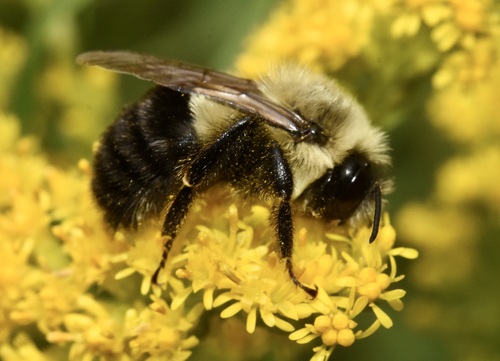
Common Eastern Bumble Bee
Bombus impatiens
The hardest worker in your garden, the Common Eastern Bumble Bee is a fuzzy, friendly powerhouse of pollination. Easily identified by its single yellow abdominal stripe, this adaptable bee is the most frequent visitor to backyard blooms across the East.
Quick Identification
Size
Workers: 8-16 mm (0.3-0.6 in); Queens: 17-23 mm (0.7-0.9 in); Males: 12-18 mm (0.5-0.7 in)
Colors
Primarily black with a distinct yellow thorax (featuring a small black central bald spot) and a single yellow band on the first segment of the abdomen.
Key Features
- Single yellow band on the first abdominal segment (T1)
- Thorax mostly yellow with a central black spot
- Short, even hair length compared to other bumble bees
- Queens are significantly larger than workers and males
When You’ll See Them
Geographic range
Where Does the Common Eastern Bumble Bee Live?
Native to the North American continent, the Common Eastern Bumble Bee occupies a massive range that spans from the Atlantic coast to the eastern edge of the Great Plains. It is most concentrated in the eastern United States and southern Canada, stretching from Ontario and Maine down to Florida and the Gulf Coast. Due to its popularity in commercial greenhouse pollination, it has also been introduced to parts of the western U.S. and Mexico, where it continues to thrive.
Basemap © OpenStreetMap contributors
Behavior
The Common Eastern Bumble Bee is a highly social insect that lives in annual colonies. Each spring, a solitary queen emerges from hibernation to find an underground cavity—often an abandoned rodent burrow—where she builds wax cells to house her first brood. Once these workers mature, they take over the foraging and nest maintenance, allowing the queen to focus entirely on egg-laying. By late summer, the colony can reach sizes of up to 400 or 500 individuals.
These bees are famous for "buzz pollination," a technique where they grab onto a flower and vibrate their flight muscles at a specific frequency to dislodge stubborn pollen. This makes them exceptionally efficient at pollinating crops like tomatoes and blueberries. Unlike honey bees, they are quite docile and rarely sting unless their nest is directly disturbed or they are handled roughly.
EverydayEarth exclusive
Camera Tips
To capture high-quality footage of the Common Eastern Bumble Bee, position your camera near "high-traffic" nectar sources. These bees have a preference for purple and blue flowers; focusing your lens on Lavender, Purple Coneflower (Echinacea), or Bee Balm (Monarda) will yield the best results. Use a camera with a macro lens or a close-focusing distance of 10-20cm. Angle the camera slightly downward to ensure you capture the diagnostic single yellow band on the abdomen, which distinguishes this species from its cousins.
Lighting is the most critical factor for insect photography. Set up your camera in a spot that receives full morning sun, as this is when the bees are most active and the light will best highlight their fuzzy textures and the iridescence of their wings. Avoid using a flash if possible, as it can wash out the subtle color transitions on the thorax. If your camera has a high-speed video or "burst" mode, use it to capture their rapid movements as they move from bloom to bloom.
If you are using a motion-triggered trail camera, look for models with a "near-field" PIR sensor or adjustable sensitivity. Because bees are small and cold-blooded, they may not trigger standard heat-based sensors. A better strategy is to use time-lapse mode set to short intervals (e.g., every 5-10 seconds) during peak morning hours. For the best composition, keep the background simple—a soft-focus green backdrop will make the bee's black and yellow colors pop in the frame.
Similar Species
Species that look similar or are commonly confused with Common Eastern Bumble Bee.
Two-spotted Bumble Bee
Look for two small yellow spots or a 'W' shape on the second abdominal segment, whereas the Common Eastern is black there.
Brown-belted Bumble Bee
Features a distinct brown or tan crescent on the second abdominal segment, and often has a much larger black bald patch on the thorax.
Frequently Asked Questions
Record Common Eastern Bumble Bee at your habitat
Connect a camera to start building your own species record — AI identifies every visitor automatically.