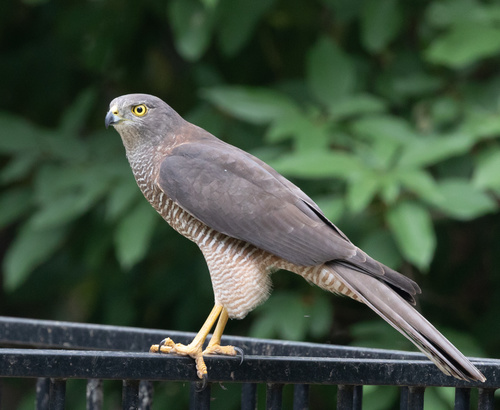
Brown Goshawk
Tachyspiza fasciata
Meet the stealthy 'blue-flier' of the Australian bush. The Brown Goshawk is a powerful, yellow-eyed hunter that turns any backyard with enough tree cover into its personal hunting ground.
Quick Identification
Size
Length: 40-55 cm (16-22 in); Wingspan: 75-100 cm (30-39 in); Weight: 250-750 g (0.5-1.6 lbs)
Colors
Slate-grey to rich brown upperparts with a distinct chestnut-colored collar. Underparts are finely barred with white and reddish-brown. Bright yellow eyes and long yellow legs.
Key Features
- Distinctive chestnut 'collar' or nape
- Rounded tail tip (especially when fanned)
- Heavy brow ridge giving an 'angry' facial expression
- Long, slender yellow legs with sharp talons
When You’ll See Them
Geographic range
Where Does the Brown Goshawk Live?
Native to the Australasian region, the Brown Goshawk is found across the entire Australian continent and Tasmania. Its range extends northwards to include New Guinea, the Solomon Islands, and parts of Indonesia, particularly the Lesser Sunda Islands. This adaptable raptor thrives in almost any environment with sufficient tree cover, from the tropical north to the temperate forests of the south.
Basemap © OpenStreetMap contributors
Behavior
The Brown Goshawk is a master of the ambush. Unlike many soaring hawks, this species prefers to stay concealed within the canopy, sitting motionless on a shaded branch while scanning for movement. When prey is spotted, it utilizes a sudden, powerful burst of flight, weaving through dense foliage with incredible agility to intercept its target.
While they are primarily solitary birds, they are fiercely territorial during the breeding season. You might hear their rapid, chattering 'ke-ke-ke' call echoing through the trees before you actually see them. In suburban environments, they have become remarkably bold, often patrolling backyard bird feeders not for the seeds, but for the smaller birds gathered there.
EverydayEarth exclusive
Camera Tips
To capture high-quality footage of a Brown Goshawk, focus your camera on a sturdy, elevated birdbath or a permanent water feature. These raptors are frequent bathers and often visit the same water source daily to drink and clean their feathers. Position your camera about 2 to 3 meters (6-10 feet) away from the water, mounted at a height of approximately 1 meter, angled slightly upward to capture the bird's full profile and impressive wingspan as it lands.
Since Goshawks are lightning-fast, camera settings are crucial. Use a 'High' or 'Very High' trigger speed setting to ensure you don't just catch a blur of feathers. If your camera allows for video, set it to the highest frame rate (FPS) possible; this will allow you to see the intricate mechanics of their flight in slow motion. Because they often hunt in the dappled light of the forest or garden, a camera with a high-quality sensor that handles high-contrast lighting will produce the best results.
While it is unethical to use live bait, providing a safe environment for songbirds (like dense shrubbery) will naturally draw Goshawks to your yard as part of their hunting circuit. If you have a trail camera in a more rural area, look for 'plucking posts'—flat-topped stumps or low horizontal branches littered with feathers. These are preferred spots where Goshawks bring their prey to de-feather it before eating. Setting a camera facing one of these posts is a surefire way to get dramatic, close-up action shots.
Similar Species
Species that look similar or are commonly confused with Brown Goshawk.
Collared Sparrowhawk
Smaller with a square-cut tail and a much thinner middle toe; lacks the Goshawk's heavy, 'angry' brow ridge.
Grey Goshawk
Comes in two color morphs: one is pure white and the other is grey and white; lacks the brown and chestnut tones of the Brown Goshawk.
Pacific Baza
Has a distinct small crest on the back of the head and much broader, bolder barring on the chest.
Frequently Asked Questions
Record Brown Goshawk at your habitat
Connect a camera to start building your own species record — AI identifies every visitor automatically.