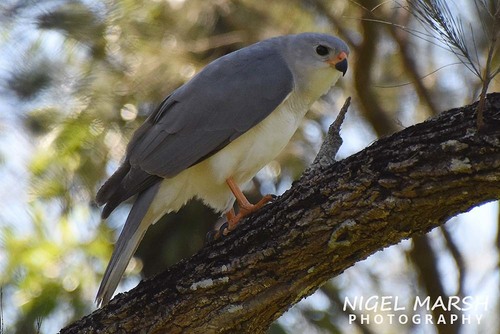
Grey Goshawk
Tachyspiza novaehollandiae
Often called the 'Ghost of the Forest,' the Grey Goshawk is one of Australia's most stunning raptors, appearing in both a slate-grey and a rare, snow-white form.
Quick Identification
Size
Length: 38–55 cm (15–22 in); Wingspan: 70–110 cm (27.5–43 in); Weight: 350–900g (0.8–2.0 lbs)
Colors
Two morphs: White morph is pure white; Grey morph has pale grey upperparts, white underparts with fine grey barring, and dark wingtips. Both have bright yellow legs and cere, with deep ruby-red eyes in adults.
Key Features
- Striking pure white plumage (in white morphs)
- Heavy, powerful yellow legs and large talons
- Deep ruby-red eyes in adults (yellow in juveniles)
- Broad, rounded wings and a longish tail
When You’ll See Them
Geographic range
Where Does the Grey Goshawk Live?
Native to the Australian continent, the Grey Goshawk is found primarily along the fertile coastal and near-coastal regions of Northern and Eastern Australia. Its range wraps around the continent from the Kimberley in Western Australia, through the Top End, and down the entire eastern seaboard into Victoria and Tasmania. While it thrives in the high-rainfall forests of the Great Dividing Range, it is a resilient species that has successfully adapted to the 'urban forests' of major cities like Brisbane, Sydney, and Melbourne.
Basemap © OpenStreetMap contributors
Behavior
The Grey Goshawk is a powerful and somewhat secretive forest hunter. Unlike many raptors that soar in wide circles over open fields, this species is an ambush specialist. It spends much of its day perched motionlessly within the mid-canopy of tall trees, using its exceptional vision to scan for movement below. When prey is sighted, the goshawk executes a sudden, explosive burst of speed, maneuvering through dense foliage with surprising agility to strike.
These birds are known for their boldness and strength, often tackling prey significantly larger than themselves. While they are generally solitary or found in pairs, they are territorial during the breeding season. In suburban areas, they have become increasingly bold, occasionally seen perched on backyard fences or garden trees where high concentrations of pigeons or lorikeets provide easy hunting opportunities.
EverydayEarth exclusive
Camera Tips
To capture a Grey Goshawk on your backyard camera, placement is critical. These birds are 'edge' hunters, meaning they love the boundary where thick trees meet an open lawn or garden. Position your camera 5 to 10 feet off the ground on a sturdy trunk, overlooking a clear flight path or a frequent perching branch. Because they are lightning-fast, ensure your camera is set to its highest trigger speed or use a video mode with a high frame rate to avoid capturing just a blur of white or grey feathers.
Water is the most effective natural lure for this species. A large, elevated bird bath or a ground-level pond will attract the smaller birds and mammals that the Grey Goshawk preys upon, which in turn brings the hawk into frame. Aim your camera at the water source from a distance of about 12 feet to account for the bird's large wingspan. They often visit water sources during the heat of the day to drink or bathe, providing excellent lighting for high-quality captures.
If you are trying to identify a resident hawk, pay attention to the 'Grey' versus 'White' morphs. The pure white morph is highly photogenic and stands out brilliantly against green foliage, but it can easily 'blow out' your exposure settings in direct sunlight. If possible, set your camera's exposure compensation to -0.5 or -1.0 to preserve the detail in their white feathers. Early morning light is often the most forgiving for these bright birds.
Similar Species
Species that look similar or are commonly confused with Grey Goshawk.
Frequently Asked Questions
Record Grey Goshawk at your habitat
Connect a camera to start building your own species record — AI identifies every visitor automatically.