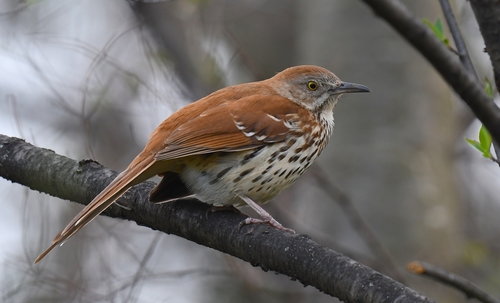
Brown Thrasher
Toxostoma rufum
A master of mimicry with a fiery rufous coat and piercing yellow eyes, the Brown Thrasher is the bold, secretive architect of the backyard thicket.
Quick Identification
Size
Length: 23–30 cm (9–12 in); Wingspan: 29–33 cm (11–13 in); Weight: 61–89 g (2.2–3.1 oz)
Colors
Rich rufous-brown upperparts with a buffy-white breast heavily marked by dark brown streaks. Features striking yellow eyes and a long, dark, slightly down-curved bill.
Key Features
- Bright yellow eyes
- Long, rufous-colored tail
- Heavy dark streaking on the underparts
- Long, slightly decurved bill
When You’ll See Them
Sightings on EverydayEarth
Jul 15, 2026
A Brown Thrasher perches on the wooden tray feeder, scanning the area before moving slightly. Shortly after, a bright yellow male American Goldfinch lands on the tube feeder to the right to feed.
Geographic range
Where Does the Brown Thrasher Live?
The Brown Thrasher is the only member of its genus found primarily east of the Rocky Mountains in North America. Its native range extends from southern and central Canada through the eastern and central United States, reaching as far west as central Texas and the Great Plains. While southern populations are year-round residents, northern birds migrate to the southern U.S. and Gulf Coast for the winter.
Basemap © OpenStreetMap contributors
Behavior
The Brown Thrasher is a secretive bird that spends much of its time in dense cover. It is famously named for its foraging behavior, where it uses its long bill to "thrash" through dry leaves and soil to uncover insects and fallen nuts. Despite being a member of the mimic family, they are generally more elusive than mockingbirds, preferring the safety of thickets and tangled undergrowth over open lawns.
While they are shy around humans, Brown Thrashers are incredibly bold when defending their nests. They are known to be one of the most aggressive bird species in North America during the breeding season, sometimes striking humans, dogs, or cats that venture too close to their hidden nests. In the spring, males perch atop high branches to sing complex, beautiful songs, typically repeating each phrase exactly twice before moving to the next.
EverydayEarth exclusive
Camera Tips
To capture the Brown Thrasher on your backyard camera, you need to focus on ground-level activity. These birds rarely spend time in the open, so place your camera 6 to 12 inches off the ground near the edge of a brush pile, hedge, or dense shrubbery. Aiming the lens at a patch of natural leaf litter is your best bet, as this is where they spend the majority of their time foraging.
You can actively lure Brown Thrashers into your camera’s field of view by creating a "scratch zone." Lightly till a small patch of earth and scatter mealworms, suet nuggets, or crushed peanuts among some dry leaves. The sound and sight of other birds foraging may also attract them, but they will feel most comfortable if there is a quick escape route into dense cover within a few feet of the bait.
Because Brown Thrashers are high-energy birds that move their heads rapidly while searching for food, use a camera with a fast trigger speed and high frame rate. Video mode is particularly rewarding with this species, as it captures their unique side-to-side thrashing motion that photos often miss. If you have a water feature, ensure your camera is positioned to catch them at the edge; they prefer shallow, ground-level bird baths and will visit them frequently during the heat of the afternoon.
Similar Species
Species that look similar or are commonly confused with Brown Thrasher.
Wood Thrush
Has a much shorter tail, dark eyes instead of yellow, and distinct round spots on the breast rather than long streaks.
Long-billed Thrasher
Very similar but has a more grayish-brown face and a more significantly curved bill; found only in South Texas and Mexico.
Northern Mockingbird
Related mimic but is primarily gray and white with conspicuous white wing patches visible in flight.
Frequently Asked Questions
Record Brown Thrasher at your habitat
Connect a camera to start building your own species record — AI identifies every visitor automatically.